
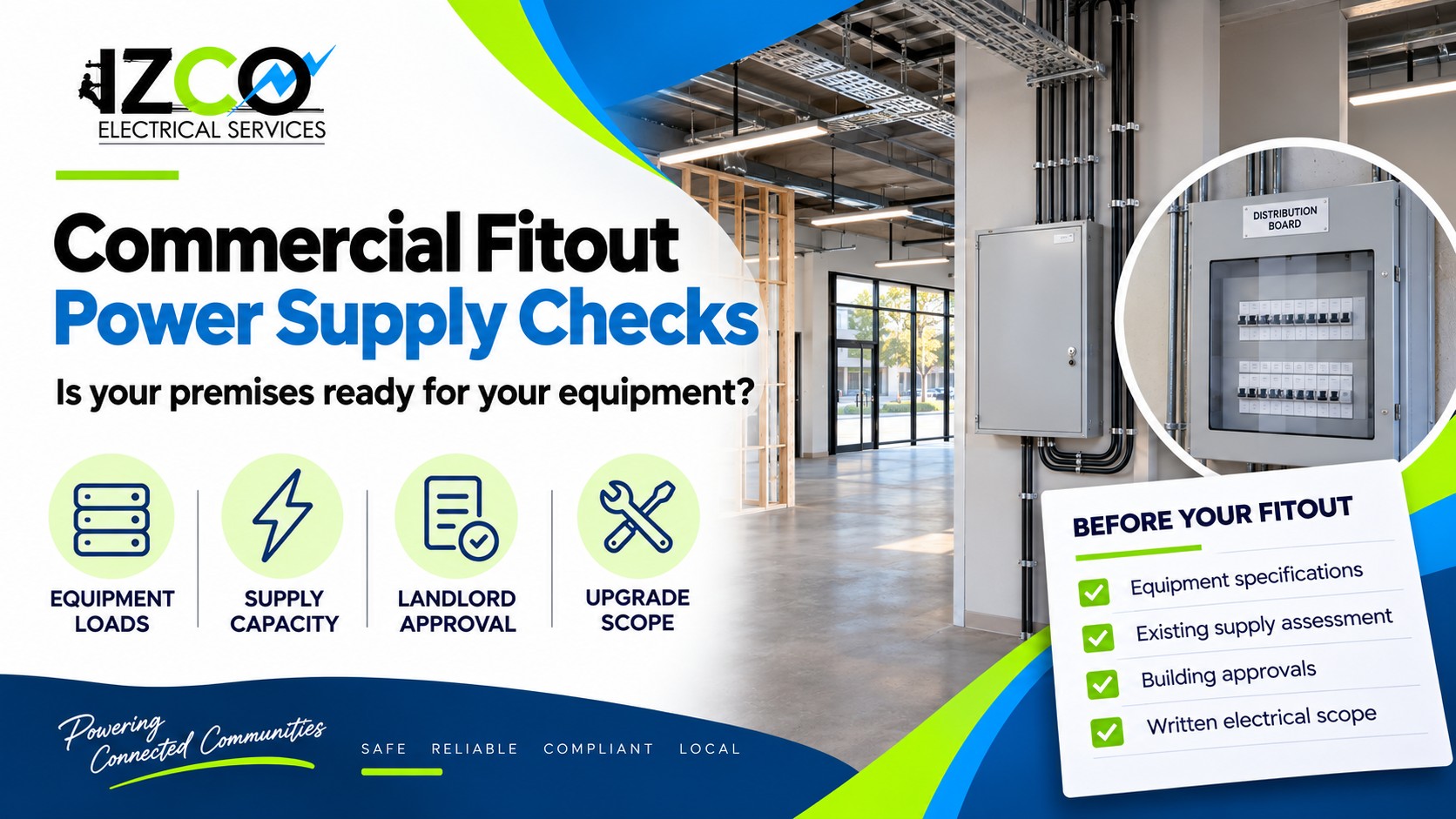
Before committing to a commercial tenant fitout, ask a licensed electrician whether the existing supply can support your proposed equipment and how it will operate together. The previous tenant’s setup, the number of power points and the size of the premises do not establish that the supply is suitable for your business.
If the assessment identifies changes to the incoming service connection, a Level 2 electrician in Sydney can help establish the appropriate connection work. Check capacity early, before ordering equipment or relying on a business opening date.
What does commercial fitout electricity supply capacity mean?
It means the electrical demand your proposed business will place on the installation and whether the supply arrangement can accommodate it. The assessment needs to consider the equipment you plan to use, existing electrical infrastructure and any limits affecting the premises.
Ask your electrician to distinguish between the supply entering the building, the distribution to your tenancy and the circuits serving individual appliances. A limitation at one point does not automatically mean every part needs upgrading.
Our overview of commercial and office electricity use in Australia provides broader background on business electricity use. Your own equipment schedule and site assessment are the information needed for a fitout decision.
What equipment information should you give the electrician?
Provide the actual equipment specifications wherever possible, rather than only describing the business as an office, café or workshop. Two businesses in the same type of premises can have very different electrical requirements.
Ask equipment suppliers for electrical connection information before finalising purchases. Include equipment you expect to add later so your electrician can explain what can be allowed for now.
- Equipment models and electrical specifications, including any stated phase requirements.
- Heating, cooling, refrigeration, cooking and other significant electrical equipment.
- Which appliances will operate together and any relevant operating cycles.
- Proposed operating hours, future additions and the planned fitout layout.
A list of equipment ratings is a starting point, not a capacity calculation you should attempt yourself. Ask the electrician to assess the expected maximum demand and explain the assumptions used.
Does the existing three phase supply mean there is enough power?
Do not treat the presence of three phase power as confirmation that the premises can support your plans. Ask the electrician to check the available capacity, the condition and suitability of the installation, and the requirements of your proposed equipment.
For example, a former retail tenancy becoming a food business may introduce different cooking, refrigeration and ventilation loads. Use the proposed equipment list to guide the assessment rather than relying on the previous business’s use.
Do you need new circuits, a switchboard upgrade or a supply upgrade?
Ask for these possibilities to be explained separately. Additional circuits serve particular equipment. A switchboard upgrade addresses work at the board. A change to the incoming supply involves a different part of the connection.
Your assessment may identify internal installation work alone, or a combination of internal and connection work. Ask why each item is recommended and which part of the installation it addresses.
A bigger switchboard enclosure does not itself establish that more supply capacity is available. Ask what the proposed work achieves before comparing quotes.
What should you confirm with the landlord or building manager?
Before authorising work, ask who can approve changes to the tenancy and any shared building infrastructure. Request available electrical drawings, previous assessment reports and information about the building’s supply arrangements.
In a shared building, ask whether the proposal affects other tenants or common equipment. Confirm access to electrical rooms and any conditions for shutdowns, contractor attendance or reinstatement.
Clarify who will arrange and pay for assessments, approvals and any agreed upgrade work. Record the agreement in writing and obtain advice on lease obligations where needed, rather than assuming the tenant or owner is automatically responsible.
When should you check with the electricity network provider?
Check with your network provider, Ausgrid or Endeavour Energy where relevant to the address, when the proposal involves a new or altered network connection. Ask your electrician or ASP to identify the correct application and technical information.
Ausgrid’s connection guidance includes options for modifying existing connections and explains that an electrician or ASP can help with technical application details. The exact process depends on the proposed connection, so confirm current requirements directly.
Keep network approval separate from contractor availability and the completion of work. Ask what is confirmed, what remains subject to assessment and who is handling each stage.
When is a Level 2 ASP needed for the fitout?
NSW’s ASP Scheme identifies Level 2 work as service connection work between the distribution network and the connection point, including specified work to energise new or altered connections. Workers also need the relevant network authorisation.
Ordinary internal fitout wiring does not automatically require a Level 2 ASP. Ask which tasks sit with the installation electrician and which, if any, require an appropriately accredited and authorised connection provider.
If the proposal also involves network design or construction, ask whether additional ASP disciplines are required. Electrical work must be performed by a licensed electrician with the appropriate accreditation and authorisation for the work involved. It is never a DIY task.
What should the electrical assessment and quote explain?
Request a written scope that connects the assessment findings to the proposed work. It should be clear enough to discuss with the landlord, fitout contractor and equipment suppliers.
- The equipment and operating assumptions used to assess demand.
- The capacity or installation limitations identified and the recommended response.
- Internal wiring, switchboard and service connection work listed separately.
- Any applications, metering coordination, shutdowns and access arrangements.
- Testing, applicable documentation, exclusions and how additional work will be approved.
Ask which costs and appointments are confirmed and which depend on further assessment. Avoid treating a general installation estimate as a guaranteed date for having usable power.
What should you do before setting an opening date?
Give the electrician your equipment schedule, premises address, proposed layout and target opening date. Include any landlord correspondence and existing connection information.
Ask for the outstanding steps to be identified before committing to a date that depends on electricity being available. If a supply change is needed, allow the programme to reflect the required approvals, contractor work and metering arrangements.
To discuss the supply connection work for your premises, request a commercial electrical supply quote from IZCO Electrical. Share your equipment plans and any assessment findings so the proposed scope can address the actual needs of the fitout.
Frequently asked questions
Can I use the previous tenant’s electricity setup?
It needs to be assessed against your proposed use. Previous operation does not establish that the installation can support a different equipment mix or operating pattern.
Will every commercial fitout need a supply upgrade?
No. Ask the electrician to establish whether the existing supply is suitable and what internal work is needed. A supply upgrade should follow the assessment rather than be assumed from the size of the fitout.
Who pays if more electrical capacity is needed?
Confirm the arrangement with the landlord or property manager and review the relevant lease terms before authorising work. Separate the assessment, installation and connection costs so responsibilities can be agreed clearly.
Can a higher electricity plan give my business more capacity?
An electricity retail plan does not establish the physical capacity of the installation. Ask your electrician about the electrical requirements and your retailer about the account and any applicable metering arrangements.