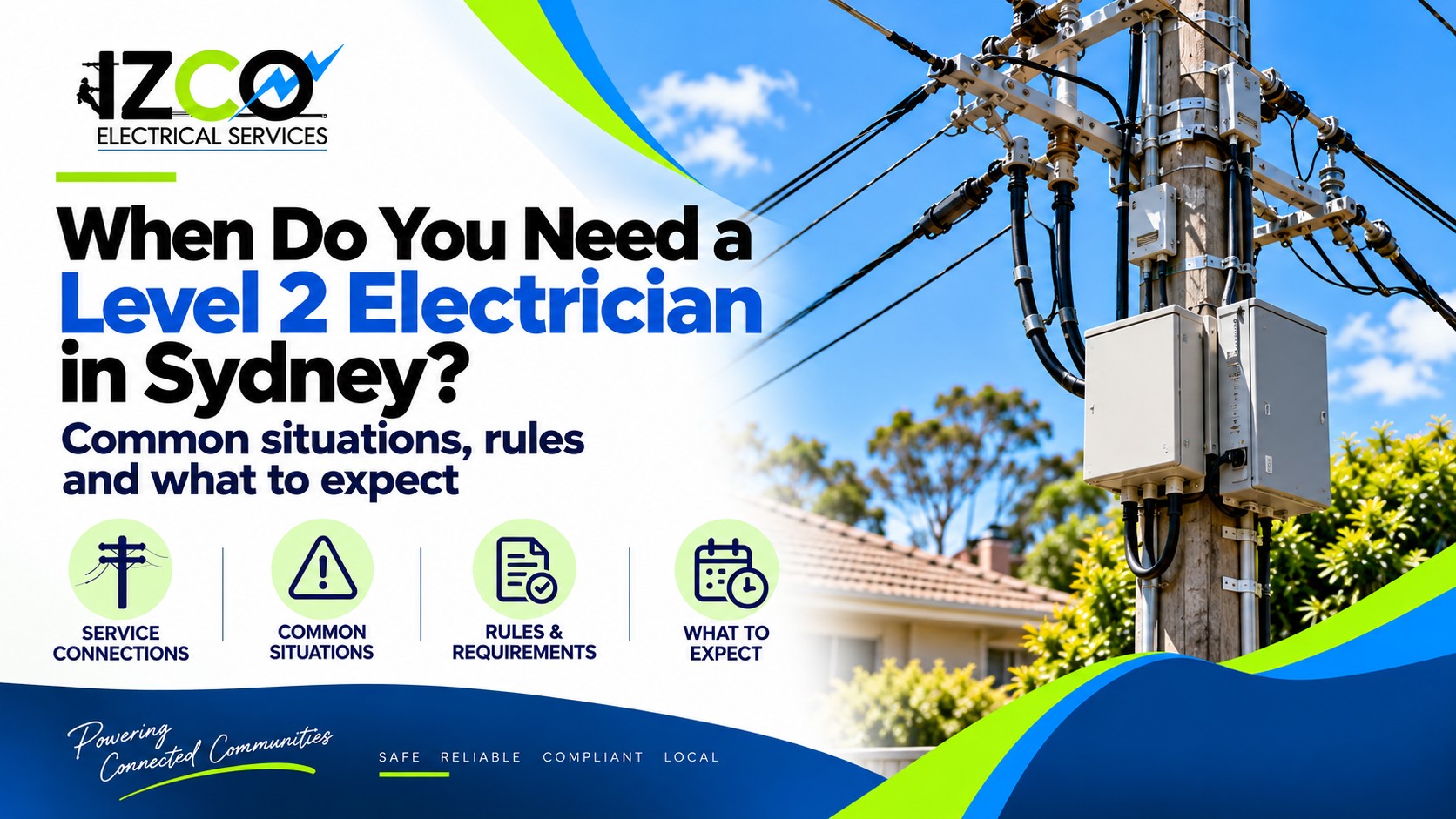
You may need a Level 2 electrician when the work affects the electrical service between your property and the electricity network. Examples include a new or changed connection, a damaged service line, certain supply disconnections and repairs named in an electrical defect notice. This work must be done by an authorised Level 2 electrician in Sydney, not a general electrician.
Work entirely inside a property doesn’t automatically need Level 2 accreditation. For lights, power points and other internal wiring, start with a licensed electrician. If the job also affects the service connection, an appropriately authorised Level 2 worker completes that part.
Quick Self-Check: Do I Need a Level 2 ASP?
Answer three questions for a fast steer, then read the situations below for detail.
- Is the issue on the supply side? Think of overhead or underground service lines, a private power pole, a damaged point of attachment or consumer mains. If yes, a Level 2 ASP is likely involved.
- Is it a connection or capacity change? A new connection, a defect notice, an authorised disconnection or reconnection, or more supply capacity for equipment such as three-phase machinery points to Level 2 work.
- Is anything unsafe right now? If so, deal with the danger first, as explained in the next section.
If you answered no to all three, the work is most likely licensed electrical work inside the property.
If Something Is Unsafe Right Now
Call Triple Zero (000) for fire, injury or immediate danger. After a switchboard fire, call 000 first. Once the site is safe, the supply usually has to be isolated and the damage assessed before power is restored, which can involve the network operator and a Level 2 provider as well as a licensed electrician. For a fallen or damaged power line, keep well away and see situation 4 below. The first-response steps are in what to do during an electrical emergency, and IZCO’s emergency electrician service covers urgent repairs once the hazard is controlled.
What a Level 2 ASP Does in NSW
An Accredited Service Provider (ASP) is a business accredited for certain electricity network services in NSW. Level 2 covers constructing or changing service lines between the distribution network and a property’s point of connection. It can also cover energising a new or altered connection and work on certain service equipment at the main switchboard. The worker must be authorised by the relevant network operator for the work they perform, so the exact scope depends on the job, the work class and the local network.
The Level 2 label does not mean one person can do every electrical task. When you ask for a quote, explain the job and ask the provider to confirm that their accreditation and worker authorisation cover it.
How Level 2 Differs From Level 1 and a General Electrician
A general licensed electrician handles lighting, power points, internal wiring and many switchboard jobs. A Level 2 ASP handles service connection work between the property and the network. A Level 1 ASP builds or changes parts of the wider distribution network, and Level 3 covers network design. Some projects need more than one specialist.
The boundary matters more than the size of the job. A large internal fit-out does not become Level 2 work because it is expensive, while a small repair at a connection point may need Level 2 authorisation. To check a provider’s accreditation before you book, see how the NSW ASP scheme works.
Nine Situations Where You May Need Level 2 Work
1. You are connecting a new property
A new home, subdivision, granny flat or commercial premises may need a new or changed electricity service. Tell the electrician whether the site already has power, whether a separate supply is planned and when building work will start. The service connection, metering and network application may be handled by different parties, so ask who coordinates them and what must be approved before power can be turned on. A granny flat does not always need a separate connection, so the existing supply should be assessed first.
2. You have received an electrical defect notice
A defect notice explains what the distributor found and what needs attention. A notice about a service line, point of attachment, private pole, consumer mains or supply equipment may involve Level 2 work, while other items can relate to the internal installation. Keep the notice and give the electrician its number, issue date and every listed item. IZCO carries out defect notice repairs involving supply connections within its authorised scope. Do not ignore the deadline written on the notice.
3. A private power pole looks damaged
A leaning pole, rotting timber, damaged fittings or storm damage needs a safe inspection. The owner may be responsible for a private pole or line, depending on where the equipment sits and who owns it. Do not touch a pole or nearby cable to test whether it is safe. Private power pole repairs and replacements begin with checking the pole’s condition, ownership and safe access, and the signs that a pole needs replacing are covered in private power pole replacement.
4. An overhead or underground supply line is damaged
A fallen branch, storm damage, excavation or a worn cable can affect the service bringing power to the property. The repair depends on whether the damaged section belongs to the distributor, the private service or the internal wiring. If you can see a fallen or low line, keep well away and warn others. Report it to your network: Ausgrid on 13 13 88, Endeavour Energy on 131 003 or Essential Energy on 13 20 80, and call 000 if there is immediate danger. Overhead service line repairs start with working out which section is damaged and who owns it.
5. The point of attachment or consumer mains need work
The point of attachment is where an overhead service is fixed to a building or other support. A loose bracket, damaged fascia connection or defect notice can make this area unsafe, and consumer mains may need repair or replacement if damaged. You don’t have to identify the faulty part yourself. Describe what you can see and share any defect notice wording, because a damaged point of attachment may need an authorised repair before the overhead supply is safe.
6. Power must be disconnected or reconnected
Renovations, demolition, tree work and changes to the incoming supply can require a formal disconnection. Switching off a breaker or the main switch is not the same as an authorised disconnection at the supply point. Reconnection may need inspection, testing and coordination before supply is restored. Explain why isolation is needed, whether the building stays occupied and when other trades are working. An authorised disconnection or reconnection is arranged around distributor notices and site work.
7. You are considering a three-phase upgrade
Three-phase power may be considered when a property needs more capacity for equipment such as large air conditioning, machinery or some EV charging setups. The first step is to assess the load and the existing supply, because an EV charger or new appliance does not by itself prove three-phase is needed. A single-phase to three-phase upgrade can involve work inside the property and a separate change to the network connection. A Level 2 ASP may handle the connection part while a licensed electrician handles the internal work.
8. A meter or meter location is changing
A new connection, relocation, solar installation or tenancy change may lead to metering work. The retailer and metering provider can be responsible for the meter itself, while a Level 2 ASP may be needed for related authorised service work. For meter installations and relocations, ask who arranges the meter, whether the switchboard or supply connection must change and whether an outage is needed. If the plan is to move equipment, moving a meter or switchboard explains who does what.
9. A building site needs temporary power
Builders may need a temporary supply before the permanent connection is ready. The arrangement can include a temporary pole or board, metering, a network application and a later changeover. A temporary power supply for construction needs to fit the building schedule, so tell the electrician whether the site already has a supply, when trades need power and where equipment can safely go. Renovation projects are covered in whether a home renovation needs a Level 2 electrician.
Jobs That Usually Don’t Need Level 2
- Installing power points and light fittings
- Replacing a circuit breaker or fuse inside the switchboard
- Repairing a fault in internal wiring
- Adding circuits for a workshop or granny flat extension
- Upgrading old internal wiring
- Electrical safety inspections of the installation
These are licensed electrical jobs. They only turn into Level 2 work if the service connection is also affected, for example when a switchboard upgrade needs an authorised disconnection or a change to the incoming supply.
Does a Switchboard Upgrade Need a Level 2 ASP?
Not always. Many switchboard upgrades are internal electrical work for a licensed electrician. Level 2 work may also be required if the job needs an authorised disconnection or reconnection, changes the incoming service, or involves particular service equipment. The same rule applies to EV chargers, solar equipment and renovations: installing them does not automatically become Level 2 work, but a change to the service connection may create a separate Level 2 task.
What if Only Your Property Has Lost Power?
First check whether neighbours have power and whether the distributor has reported an outage. If a wider area is affected, the distributor may already be responding. If only your property is affected, the fault could be inside the property, at the service connection or in nearby network equipment. Tell the electrician whether you can see damage, whether safety switches have tripped and whether there is a defect notice. Avoid opening sealed equipment or touching damaged wiring, and call 000 for immediate danger to life.
Who Is Responsible for a Damaged Line or Pole?
Ownership is one of the first questions to settle. The distributor looks after its network, while owners may be responsible for private poles, private lines and parts of their installation. The boundary is not always obvious from the street, and it can depend on the connection arrangement and the equipment named in a defect notice.
Don’t book a replacement just because a cable crosses your land. Give the electrician the address and any notice or distributor reference number, and ask them to identify the damaged asset, confirm who owns it and explain whether the distributor must isolate or repair part of the supply. This avoids delays and quotes for the wrong work.
Frequently Asked Questions
Do I need a Level 2 electrician to install a new power point?
No. Power points and light fittings are licensed electrical work. Level 2 only applies if the supply connection is also being altered.
Is there such a thing as an emergency Level 2 electrician?
Yes. Urgent supply faults, damaged service lines and unsafe connections may need a Level 2 provider once emergency services have made the site safe.
Can a general electrician repair an electrical defect?
It depends on what the notice says. A defect in internal wiring is different from one affecting the service connection or private supply equipment. Show the whole notice to a suitably licensed contractor and ask whether a Level 2 ASP is needed for any item.
Does a Level 2 electrician work on the whole street network?
No. Level 2 covers specific connection services. Work on wider distribution assets can fall under Level 1, and network design under Level 3.
Will I need to turn the power off?
Some jobs require a planned outage or authorised disconnection, and others don’t. Ask which parts need isolation, who arranges it and when power is restored. If anyone relies on electricity for medical equipment, say so when planning.
Does every meter change need a Level 2 electrician?
No. Your retailer or metering provider may arrange the meter itself, and related changes to the service connection may need a Level 2 ASP.
Does an EV charger mean I need three-phase power?
No. It depends on the charger, the existing supply and the property’s demand. A Level 2 ASP is only involved if the network connection needs to change.
How long will the job take?
Timing depends on the work, access and any approvals. A small repair is quicker than a new connection or major supply change, and an inspection can clarify the sequence.
Do I need to know if the fault is overhead or underground?
No. Describe what happened and what you can safely see, and the electrician will assess the equipment. If you see a fallen line or exposed live parts, keep away and report the hazard.
What Should You Do Next?
With a defect notice, a damaged private pole, a new connection or an incoming supply problem, give IZCO your suburb and a short description and the team will identify the right next step. Get a free quote or phone 0470 123 811.