
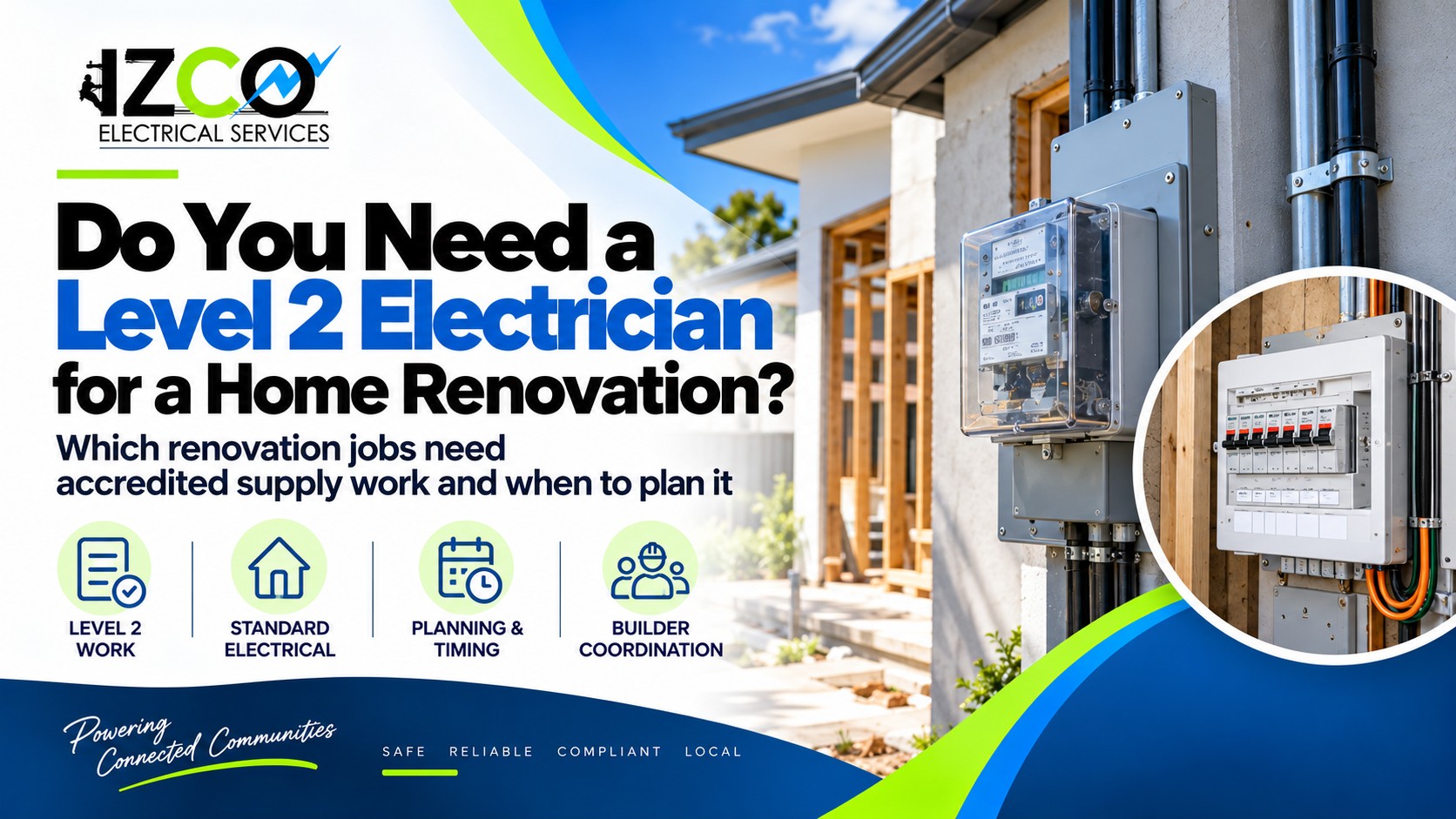
Most renovation electrical work, such as new lights, power points and internal circuits, is done by a licensed electrician. Work that changes the connection between your property and the electricity network is different, and it needs an accredited Level 2 Accredited Service Provider (ASP). The key is finding out which applies before structural work starts, when changes are still cheap.
If your plans touch the service cable, a private pole, the meter or the incoming supply, speak to a Level 2 electrician in Sydney before the design is final. The Level 2 category itself is explained in what Level 2 electrical service work is.
Renovation Jobs That May Need Level 2 Work
Moving an overhead service line. An extension, raised roof or new balcony can interfere with the cable or point of attachment, and clearances must be maintained. Approved service-line work may be needed before building begins, which falls under overhead powerline installation.
Relocating a private power pole. A new driveway, garage or extension may conflict with the pole, which may need relocating or replacing, or the service route may need to change. Ownership, foundation and safe isolation all matter, and power pole work covers these.
Changing the incoming supply. Adding substantial equipment can prompt a capacity review. Some properties take extra load without a supply change, while others need an upgrade or more phases. The network’s available capacity decides what’s feasible, and single-phase vs three-phase power explains the options.
Moving the meter. This involves the metering provider as well as authorised connection work, and not every meter exchange is a Level 2 task. Moving a meter or switchboard explains who does what.
Disconnecting and reconnecting power. Demolition or major structural work can require approved isolation of the incoming supply, which differs from turning off an internal breaker and may need authorised personnel. See disconnection and reconnection.
Jobs That Usually Don’t
- New or relocated power points and light fittings
- Extra circuits for appliances
- Rewiring inside the property
- Safety switches, fans and downlights
- Many switchboard upgrades that don’t touch the supply
A kitchen, bathroom or air-conditioner install does not need Level 2 accreditation unless the supply connection is actually affected.
Why Timing Matters
A builder may need a cable moved before a new roof goes up, or a meter relocated before a wall is built. Wait until the structure is finished and access may be blocked or the design forced to change. Include electrical supply in planning before demolition and structural work, particularly when building lines or clearances are changing, and ask the electrician to identify which stages depend on the distributor, the metering provider or the builder.
How to Plan It
- Describe the building work, including extensions, demolition and new equipment.
- Arrange an assessment of existing circuits, the switchboard and supply capacity.
- Identify any service lines, private poles, meters or attachment points the design affects.
- Separate ordinary licensed tasks from Level 2 tasks.
- Confirm approvals, outages and who arranges them.
- Sequence the electrical stages with your builder and keep the documents.
Before you call, gather your plans, photos of the meter and service area, and any defect notice, as set out in what to send a Level 2 electrician before supply work.
Working With Your Builder
Give the builder’s current plans, showing the roofline, driveway, extension and meter area, to the electrician, who can then see where the incoming route might conflict with construction. If a supply interruption is needed, confirm who arranges it. A permanent connection, a temporary builder’s supply and an internal circuit isolation are different stages with different responsibilities, so keep them separate in the schedule.
Temporary Power on Construction Sites
A renovation, knock-down rebuild or new dwelling may need temporary construction power and a separate permanent supply. Before excavation, demolition or major structural work, establish:
- Whether the existing supply, meter or service cable must be disconnected or moved
- Where temporary power goes, and how it will be metered and protected
- Whether the project adds a private pole, new attachment point, underground route or capacity change
- Who organises distributor approval, outages and reconnection
- When the permanent supply, testing and records must be ready for handover
Temporary power doesn’t automatically become the final connection. See temporary power supply for how it’s arranged, and send drawings, load details and the construction timetable early to avoid rework.
What Does Renovation Supply Work Cost?
It depends on what changes. Moving a service cable, replacing a private pole, upgrading consumer mains and altering metering are not equivalent projects. Access, excavation, existing equipment and distributor coordination affect price. A useful quote separates ordinary rewiring and switchboard work from network connection work, metering and making good. One generic renovation electrical price doesn’t fit every property.
Four Scenarios
- Kitchen refit, no supply change: licensed electrician, with a capacity check if needed.
- Second storey under an overhead line: assess clearances and relocate the service before the structure reaches that area.
- Garage conversion with a private pole in the way: work out a compliant relocation or connection redesign before footings and paving go in.
- Whole-house renovation with more load: changes inside the property and possibly at the connection. It doesn’t always need three-phase, and a load and network assessment decides.
Strata and Multi-Unit Renovations
A unit’s wiring may be controlled differently from the building’s shared equipment. Access to electrical rooms, metering enclosures and common-property routes may need the owners corporation or building manager. An alteration that seems to stay inside one unit can affect a shared route or board, so identify who is responsible and plan outages before authorising work on common infrastructure.
What to Ask Your Electrician
- Will the renovation affect incoming cables, the meter or a private pole?
- Is the planned load compatible with the existing service and board?
- What approvals or network coordination are needed?
- Who performs authorised connection tasks and arranges outages?
- Can the work be done before walls or roofs close in?
- What tests and documents will I receive?
Frequently Asked Questions
Does a kitchen renovation need a Level 2 electrician?
Not automatically. Internal kitchen wiring is ordinary licensed work, and Level 2 is only needed if the incoming service or connection equipment must change.
Do I need Level 2 work to install an air conditioner?
Usually not. It only becomes relevant if the project needs an approved network supply alteration.
Can a Level 2 electrician move my meter?
Metering work may involve an appointed metering provider as well as eligible Level 2 connection tasks. Identify the responsible parties first.
Can I build an extension under an overhead cable?
Not without checking safety clearances and structural requirements. The line may need approved alteration first.
Is three-phase needed for a home office?
No. Ordinary office equipment typically runs on single-phase, and load and existing capacity decide whether an upgrade is warranted.
Will my renovation require the supply to be disconnected?
Some do, especially with demolition or authorised service work. Internal circuit work needs safe isolation but not always a network disconnection.
When should I arrange the assessment?
Before finalising structural changes, service routes or trade schedules that could affect the incoming supply.
Planning a Renovation? Ask Early
Supply questions are cheapest to answer before walls close up. IZCO Electrical covers both the licensed electrical work and the Level 2 supply work for Sydney renovations as a Grade A ASP. Share your plans and we’ll tell you what applies. Request a call back or phone 0470 123 811.