
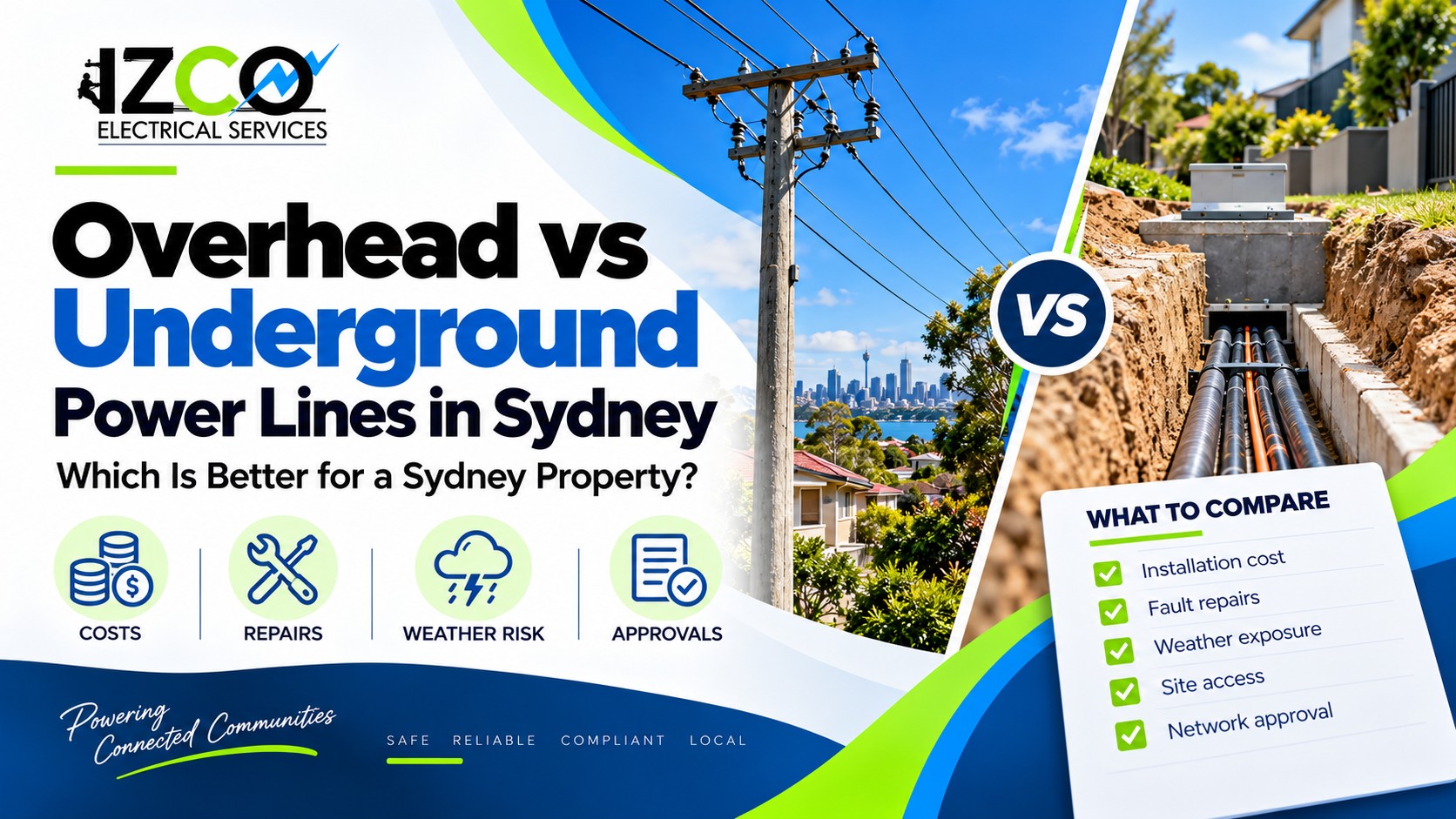
Neither is better everywhere. An overhead connection is usually quicker and cheaper to install or repair where a suitable pole and attachment point already exist. An underground connection removes the visible span and some weather exposure, but it needs a workable cable route, trenching and network approval. Which one you can have depends on your street’s supply, your site and the network operator’s rules.
If the choice involves changing the service connection itself, the work normally sits with an accredited Level 2 electrician rather than a general electrician.
What Is the Difference?
An overhead service line carries electricity above ground from the network to an approved attachment point on your building or a private power pole. Safe clearances and the existing network arrangement decide what can be installed.
An underground connection runs through buried cable in approved protective arrangements. Some equipment, such as a pillar or meter enclosure, stays above ground. IZCO Electrical installs underground power connections where the route and connection point suit the property and the network’s requirements.
Overhead vs Underground: The Main Trade-Offs
- Upfront work: Overhead – Often less excavation where a suitable pole and attachment exist | Underground – Trenching, conduit, cable routing and reinstating surfaces
- Weather exposure: Overhead – More exposed to falling branches, wind and pole damage | Underground – Avoids most above-ground hazards, but water ingress and excavation damage still occur
- Faults and repairs: Overhead – Faults are often visible and easier to reach | Underground – Locating a fault can need specialised testing and sometimes digging
- Appearance and clearance: Overhead – Needs clearance from buildings, trees and vehicle areas | Underground – Removes the visible span across the property
- Long-term upkeep: Overhead – Needs compliant equipment and periodic checks | Underground – Needs compliant equipment and protection from future digging
Neither system comes with a guaranteed lifespan or uninterrupted supply. Materials, installation quality and site conditions matter more than the category.
When an Overhead Connection Makes Sense
Overhead supply is worth keeping when the property already has an acceptable pole and service arrangement, excavation would be disruptive, and there is enough clearance for the connection. Repairing an existing service line or point of attachment is often simpler than changing the whole supply route.
The main limits are weather, vegetation and physical damage. A roof extension or new structure can also create a clearance problem that did not exist before. New connections, repairs and replacements of this kind are covered under overhead powerline installation, and the parts of the connection are explained in how an overhead service line is made up.
When Underground Power May Suit Better
Underground can suit a new build, a major renovation or a site where an overhead span conflicts with the design. It can reduce exposure to trees and wind along the service route and leave outdoor areas looking cleaner.
The trade-off is what is under the surface. The route may pass driveways, retaining walls, landscaping or other buried services, and soil conditions, access and reinstatement all affect feasibility and cost. Underground supply should be assessed, not assumed.
Can You Change From Overhead to Underground?
Sometimes, but you cannot choose a route and start digging. In areas supplied by overhead mains, the network operator decides which connection arrangements are acceptable, and Ausgrid, Endeavour Energy and Essential Energy each set their own requirements.
A proper assessment confirms whether a suitable cable route exists, which assets belong to you and which to the network, whether a private pole or point of attachment must change, and who coordinates the connection and any shutdown. If a pole is part of the picture, choosing between replacing, relocating or removing it is a separate decision, covered in private power pole replacement.
How Much Do the Two Options Cost?
No single price difference applies to every Sydney property. A straightforward overhead replacement can cost less upfront than digging a new underground route, while a complicated overhead relocation or pole replacement can also be a substantial job.
- Overhead: service-line length and condition, the attachment point or pole, access, clearances, and whether disconnection and reconnection are needed.
- Underground: cable length and route, excavation conditions, conduit and protection, driveway or landscaping reinstatement, and the network connection arrangements.
Ask for a site-specific quote that separates electrical connection work from excavation and reinstatement, and be cautious of broad percentage-saving claims that are not based on your property.
Does the Choice Affect Solar, EV Charging or a Three-Phase Upgrade?
Not directly. Whether your connection is overhead or underground does not decide how much power you can use. The size of the supply, the network operator’s approval and the equipment at your property decide that.
If you are planning solar, an EV charger or a move to three-phase power, check these before choosing a route:
- Supply capacity: confirm whether your current service line, meter and switchboard can carry the extra load. The single-phase vs three-phase guide explains the difference.
- Network approval: the network operator decides what connection arrangements are acceptable for your street and site.
- The service line itself: an old or undersized overhead line may need replacing as part of the upgrade, which is covered in upgrading overhead power lines.
Treat the overhead or underground decision as one part of the wider upgrade plan. Ask your electrician to assess both together so you do not pay to change the connection twice.
What If a Defect Notice Started This?
A damaged private pole, unsafe service line or faulty attachment needs fixing, but a defect notice does not automatically mean converting to underground. Depending on the defect and who owns the equipment, the fix may be a repaired point of attachment, a new pole, a new service line or a redesigned connection. Follow the deadline on the notice and arrange an assessment promptly. Defect notice repairs explains how that work is scoped.
Five Checks Before You Choose
- What already serves the property? Confirm whether the street and your connection are overhead, underground or a mix.
- Why is it changing? A defect repair, renovation, new build and capacity upgrade can need different answers.
- What is on the route? Consider trees, rooflines, driveways, buried services and clearances.
- What approvals are needed? Your contractor should confirm network conditions, the authorised scope and any disconnection.
- What does the quote include? Compare installation, removal of redundant equipment, excavation, reinstatement and separate network charges.
Frequently Asked Questions
Are underground power lines always safer than overhead lines?
No. Underground cable avoids some above-ground hazards but introduces others, mainly damage from digging and water ingress. Either system must be designed, installed and maintained correctly.
Will going underground stop power outages?
No. It reduces the risk from trees and weather acting on an exposed service cable, but outages can still start elsewhere in the network or in electrical equipment.
Do underground connections always cost more?
They usually involve more civil work at installation, but the total depends on the property. A site inspection is needed for a useful comparison.
Can a private power pole be removed?
Possibly, if another compliant connection is available and the network approves it. Ownership, existing equipment, the route and nearby services have to be checked first.
Not Sure Which Supply Suits Your Property?
Underground or overhead, the right answer depends on your street, your site and your network. IZCO Electrical is a Grade A Accredited Service Provider that works on both across Sydney. Tell us your address and we’ll explain what is possible: request a call back or phone 0470 123 811.