
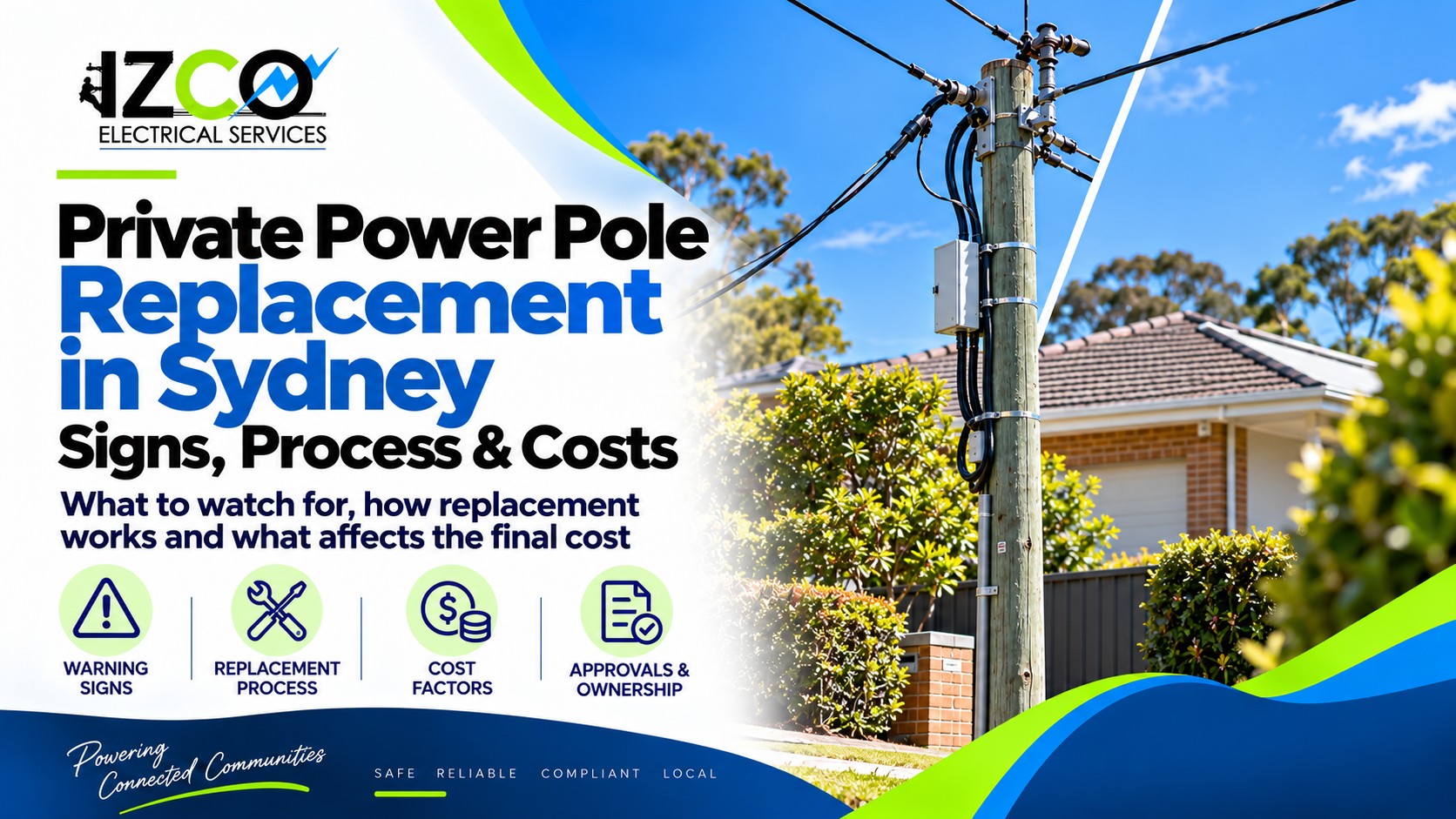
A private power pole is part of the electricity supply for some Sydney properties. It supports the incoming overhead line where the street connection can’t attach directly to the building. When it becomes unstable, corroded or otherwise unsafe, replacement may be needed to protect people and restore a compliant connection.
This article is about replacing a pole that already exists. If you are installing a new pole or moving one, read private power pole installation, and for the material choice see timber vs steel poles. If the pole is leaning, damaged or subject to a defect notice, get it assessed by a Level 2 ASP before anyone touches it.
How Do You Know a Private Pole Needs Replacing?
There is no universal replacement age. Timber, steel and other approved materials deteriorate differently depending on weather, installation, ground conditions, maintenance and damage, so a qualified inspection is the sound basis for deciding between repair and replacement. Signs to act on:
- The pole leans, moves at the base or shows foundation failure
- Timber is split, rotting or damaged by termites or other pests
- Steel sections or fittings are badly corroded or deformed
- A branch, storm or vehicle has struck it
- The point of attachment or cable clearance no longer looks secure
- The distributor has issued a defect notice
Don’t test a pole by pushing it or climb it to inspect the cable. A damaged service connection can still be live.
What a Defect Notice Means
A distributor can issue a notice for a pole, attached wiring, clearance, service protection equipment or another component that is unsafe or doesn’t meet connection requirements. Follow its instructions and timeframe, and don’t assume every notice requires a new pole. An authorised assessment shows what’s needed, and defect notice repairs explains how the work is scoped.
The Replacement Process
- Inspect the pole and service connection. Identify the defective equipment, ownership and access.
- Confirm the replacement design. Agree the pole type, location, foundation, height and clearances.
- Plan approvals and isolation. The contractor coordinates distributor requirements and the outage.
- Install the new pole. Equipment, foundation and lifting method depend on the property.
- Transfer the service connection. Authorised personnel do the electrical work.
- Test, document and reconnect. Checks and paperwork are completed before supply returns.
Tree clearing, excavation, restricted machinery access and nearby buildings or fences affect both the plan and the time. A new pole shouldn’t simply go into the old hole without confirming the footing: erosion, drainage problems, nearby digging and vehicle movement can change the ground, and a pole can lean because its base is compromised even when the top looks sound.
Replace, Relocate or Go Underground?
Replacing in a similar approved position is often the most direct fix when the existing connection design is still suitable. Relocation is worth assessing when a driveway, extension or clearance problem makes the position impractical, and an underground connection can avoid the overhead span but usually needs excavation and a different approved arrangement. These are not interchangeable, and the cheapest-looking option can leave out consumer mains work or reinstatement. The route and maintenance trade-offs are compared in overhead vs underground power lines.
What Affects the Cost?
- Pole specification, height, material and foundation
- Access for crews and machinery
- Ground conditions, excavation and removal of the old pole
- Changes to the service cable, attachment or metering
- Distributor coordination, isolation and reconnection
- Storm damage or urgent access constraints
A trustworthy quote shows what’s included, what may need further approval and whether reinstatement is covered. Prices differ widely between properties, so generic online ranges are no substitute for an assessment. Ask what happens to the old pole, its footing and redundant cables, and which landscaping or paving will be restored.
Who Can Replace a Private Pole?
The structural work and the service connection need competent, licensed and authorised people. The network-related part may need a Level 2 ASP with the relevant distributor authorisation, and owners shouldn’t disconnect, move or reattach service cables themselves. IZCO’s private power pole services are carried out under its Grade A ASP accreditation.
Before the Inspection
- Photos from a safe distance and your property address
- Any defect notice or previous inspection report
- Details of access limits, trees or driveway works
- Plans to move the pole or change the supply
- A contact person to coordinate the outage
During the work, keep vehicles, children and pets away from the zone and ask for the expected power-off window, especially if anyone relies on essential electrical equipment.
Frequently Asked Questions
Will the power need to be switched off?
Usually. Replacement needs a planned isolation of the connection, arranged with the distributor as needed.
Does a leaning pole always need replacing?
Not necessarily, but it needs prompt professional assessment. The pole and foundation condition decide the safe fix.
Can I keep using electricity after a defect notice?
Follow the notice and network instructions. If you suspect immediate danger, keep clear of the equipment and call the relevant emergency service.
How long does replacement take?
It depends on approvals, access, excavation, weather and reconnection. An uncomplicated site can differ hugely from one needing redesign, so ask for a schedule specific to your job.
Can a private pole be replaced in the same place?
Often, but only if the position still gives suitable clearances and access under current requirements. Renovations around the pole can force a new location.
Do pole repairs need council approval?
It depends on the location and scope. The contractor should check for planning, access or infrastructure approvals before work starts.
Replace a Damaged Pole Before It Fails
A leaning or rotting private pole is cheaper to replace on your schedule than after a supply failure. IZCO Electrical assesses and replaces private poles across Sydney as a Grade A ASP. Arrange an assessment through the power pole page or phone 0470 123 811.