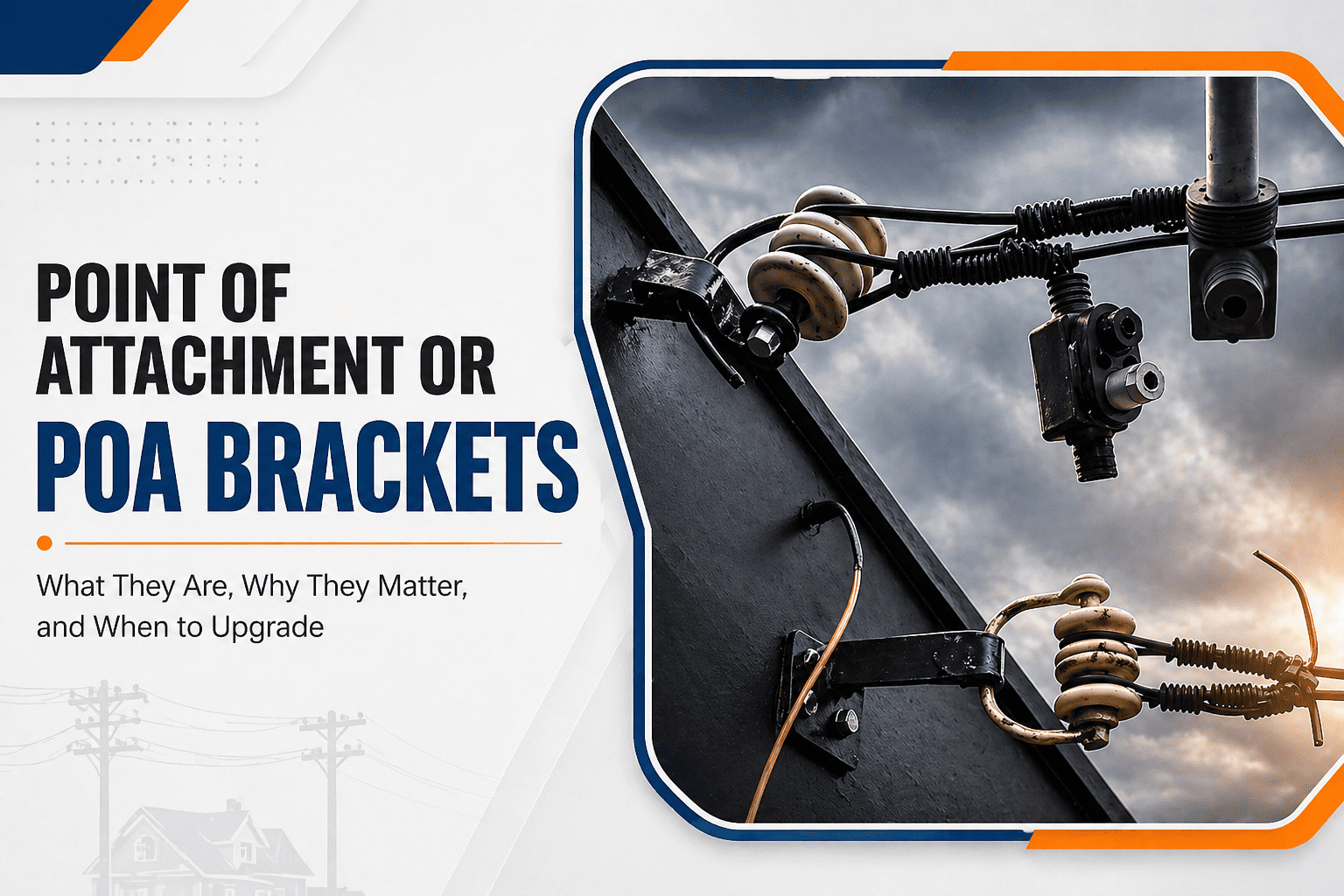
Point of attachment or POA brackets are brackets that hold the weight of the service cable line from your home or building to the network pole. A connection is made at the POA, and in some cases, the bracket must be connected to the neutral service line. POA brackets are available in many different shapes and sizes, although they must be approved by the network in order for a Level 2 electrician to use them. Some different types of point of attachment brackets include rafter brackets, fascia brackets, J hooks, I bolts, and, in special conditions, riser brackets.
Now that you have a basic understanding of POA brackets, it is important to look at the connection point itself and why it plays such a critical role.
What is Point of Attachment (PoA)?
A point of attachment is more than just a connection point. It is where responsibility shifts from the network provider to the property owner. Everything from that point into your property depends on how well this connection is installed and maintained.
Think of it as the gateway for electricity entering your home. If this gateway is weak, unstable, or incorrectly installed, the entire system becomes vulnerable.
The bracket itself plays a structural role. It holds the cable firmly in place while maintaining the correct height and tension. This ensures that the cable does not sag, rub against surfaces, or become a hazard.
If you are dealing with an existing issue or planning a new setup, it is worth exploring professional Point of Attachment services to get it done properly.
Why POA Brackets Matter More Than Most People Realise
It is easy to overlook something that sits quietly on your roof or wall, but POA brackets are constantly under stress. They deal with weight, tension, weather exposure, and movement over time.
Here is a deeper look at their importance:
- They carry the full mechanical load of incoming service cables
- They maintain proper clearance from the ground and surrounding structures
- They prevent long-term strain on electrical connections
- They support compliance with strict Australian electrical standards
- They protect your property from potential hazards during storms
At IZCO Electrical, many emergency callouts are linked to POA issues that could have been prevented with proper installation or timely maintenance. A loose or damaged bracket can quickly turn into a power outage or a safety concern.
Types of Point of Attachment Brackets (POA Brackets)
Selecting the right point of attachment bracket is a technical decision. It is not just about what fits. It is about what works safely and complies with network rules. Below is a detailed breakdown of each type, including when and why it is used.
Rafter Brackets
Rafter brackets are among the most secure options available. These brackets are fixed directly to the roof rafters, which are the main structural beams of the roof.
Because they are anchored into a strong framework, they can handle higher loads and greater tension. This makes them ideal for properties where the service line spans a longer distance or is exposed to stronger environmental forces.
They are often used in:
- Areas prone to high winds
- Installations with heavier service cables
- Situations requiring maximum structural strength
At IZCO Electrical, we often recommend rafter brackets when durability is the top priority.
Fascia Brackets
Fascia brackets are attached to the fascia board along the roof edge. These are commonly used in residential installations where the structure allows for easier access.
They are suitable for moderate load conditions and are often chosen for their simplicity and practicality. However, they still require careful installation to ensure they can handle the cable tension over time.
Fascia brackets are typically used in:
- Standard residential properties
- Shorter cable spans
- Situations where roof access is limited
While they may seem straightforward, incorrect installation can lead to long-term issues.
J Hooks
J hooks are a lighter and simpler option compared to other brackets. They are shaped like the letter “J” and are designed for straightforward applications.
They are often used when:
- The load on the cable is minimal
- The installation is temporary or less complex
- A quick solution is required
Despite their simplicity, J hooks must still meet network approval standards. At IZCO Electrical, we ensure that even the simplest installations meet all safety requirements.
I Bolts
I bolts are used when a strong and direct anchor point is needed. These are installed through solid materials such as brick or timber, providing a secure fixing for the service cable.
They are particularly useful in:
- Installations requiring precise positioning
- Situations where other brackets are not suitable
- Properties with solid structural surfaces
I bolts are a reliable option when strength and stability are both essential.
Riser Brackets
Riser brackets are designed for more complex scenarios. These are used when the cable needs to be raised or redirected to meet clearance requirements.
They are often required in:
- Multi level buildings
- Properties with unusual layouts
- Installations where height adjustments are necessary
Riser brackets require careful planning and professional installation to ensure compliance.
The Complete Point of Attachment Installation Process
A proper point of attachment installation is a step by step process that involves more than just mounting a bracket.
Initial Assessment
The process begins with a detailed inspection of the property. This includes evaluating the structure, identifying the best cable path, and determining the appropriate bracket type.
Planning and Compliance
Next comes planning. This involves ensuring that all materials and methods meet the requirements set by local energy providers. At IZCO Electrical, we work closely with network standards to ensure every job is compliant.
Installation
The bracket is installed securely using the correct method for the chosen type. This step requires precision and experience, as even a small error can affect the entire system.
Connection and Testing
Once the bracket is in place, the service cable is connected, and the system is tested to ensure everything is working correctly.
Working with a qualified Level 2 Electrician ensures that every step is handled professionally.
Environmental Factors That Affect POA Brackets
One aspect that is often overlooked is how environmental conditions impact point of attachment brackets over time.
Weather Exposure
Constant exposure to sun, rain, and wind can weaken materials. Over time, this can lead to corrosion or structural fatigue.
Wind Load
Strong winds can place additional tension on service cables, which directly affects the bracket. This is why choosing the right type is so important.
Temperature Changes
Expansion and contraction due to temperature variations can loosen fittings and reduce stability.
At IZCO Electrical, we take these factors into account when recommending solutions, ensuring long-term reliability.
Common Problems with Point of Attachment Electrical Systems
Even a well installed system can develop issues over time. Some of the most common problems include:
- Corrosion or rust on metal components
- Loose or unstable fittings
- Incorrect installation from previous work
- Damage caused by storms or debris
- Defect notices issued by energy providers
These issues should never be ignored. Early action can prevent more serious problems.
When Should You Replace Your POA Bracket?
There are clear signs that indicate it is time for a replacement:
- Visible wear or damage
- Movement or instability in the bracket
- Upgrading your electrical system
- Receiving a defect notice
- Renovating or extending your property
IZCO Electrical provides fast and reliable replacement services, ensuring minimal disruption to your power supply.
Safety and Compliance in Australia
Electrical work in Australia is heavily regulated, and point of attachment installations are no exception.
Energy providers have strict guidelines regarding:
- Approved materials
- Installation methods
- Clearance requirements
- Load capacities
Failure to meet these standards can result in disconnection or penalties.
This is why it is essential to work with experienced professionals who understand these requirements.
Why IZCO Electrical a Trusted Choice
At IZCO Electrical, point of attachment work is part of our everyday service offering. We bring a practical understanding of what works and what does not.
Our approach is simple. Do the job right the first time and ensure it lasts.
We are known for:
- Over 16 years of experience in Level 2 electrical work
- Full accreditation and authorisation
- Fast response times for urgent jobs
- Transparent communication and pricing
- A strong reputation backed by real customer reviews
We also handle everything from minor repairs to complete system upgrades, making us a reliable choice for any POA related work.
Get Expert Help Today
If you are dealing with a point of attachment issue or planning a new installation, it is always better to get expert advice early.
You can Request a Quote and speak with a team that understands exactly what your property needs.
Final Thoughts
Point of attachment or POA brackets may seem like a small detail, but they play a major role in keeping your electrical system safe and functional.
From supporting service cables to maintaining compliance, they are an essential part of your connection to the network.
By understanding how they work, the types available, and the importance of proper installation, you can make informed decisions that protect your property in the long run.
And when it comes to getting the job done right, IZCO Electrical brings the experience and reliability you can count on.
Frequently Asked Questions
What is a point of attachment in an electrical service?
The point of attachment is the location where the overhead service cable is secured to the property before it connects into the property’s electrical installation. If the attachment is loose, damaged or unsuitable, it can affect the safety of the service connection. IZCO Electrical can inspect and repair or replace the point of attachment as authorised Level 2 work where required.
What are the signs that a point of attachment needs repair?
Warning signs can include visible damage, movement, corrosion, a loose bracket, sagging service cables or a defect notice referring to the attachment point. Because this area is associated with the network supply connection, it should not be treated as a DIY repair. IZCO Electrical can assess the condition and complete the necessary repair or replacement.
Can a damaged point of attachment cause a power supply problem?
Yes. Damage around the service attachment can place stress on the incoming cable and may contribute to supply faults or an unsafe connection. IZCO Electrical can inspect both the attachment and related service components so the repair addresses the actual cause instead of only the visible bracket.
Who should repair a point of attachment in Sydney?
Work involving the incoming overhead service and its attachment can require a suitably authorised Level 2 ASP. IZCO Electrical provides Level 2 point of attachment repair and installation services in Sydney and can determine whether the job also needs service-main, disconnection or reconnection work.