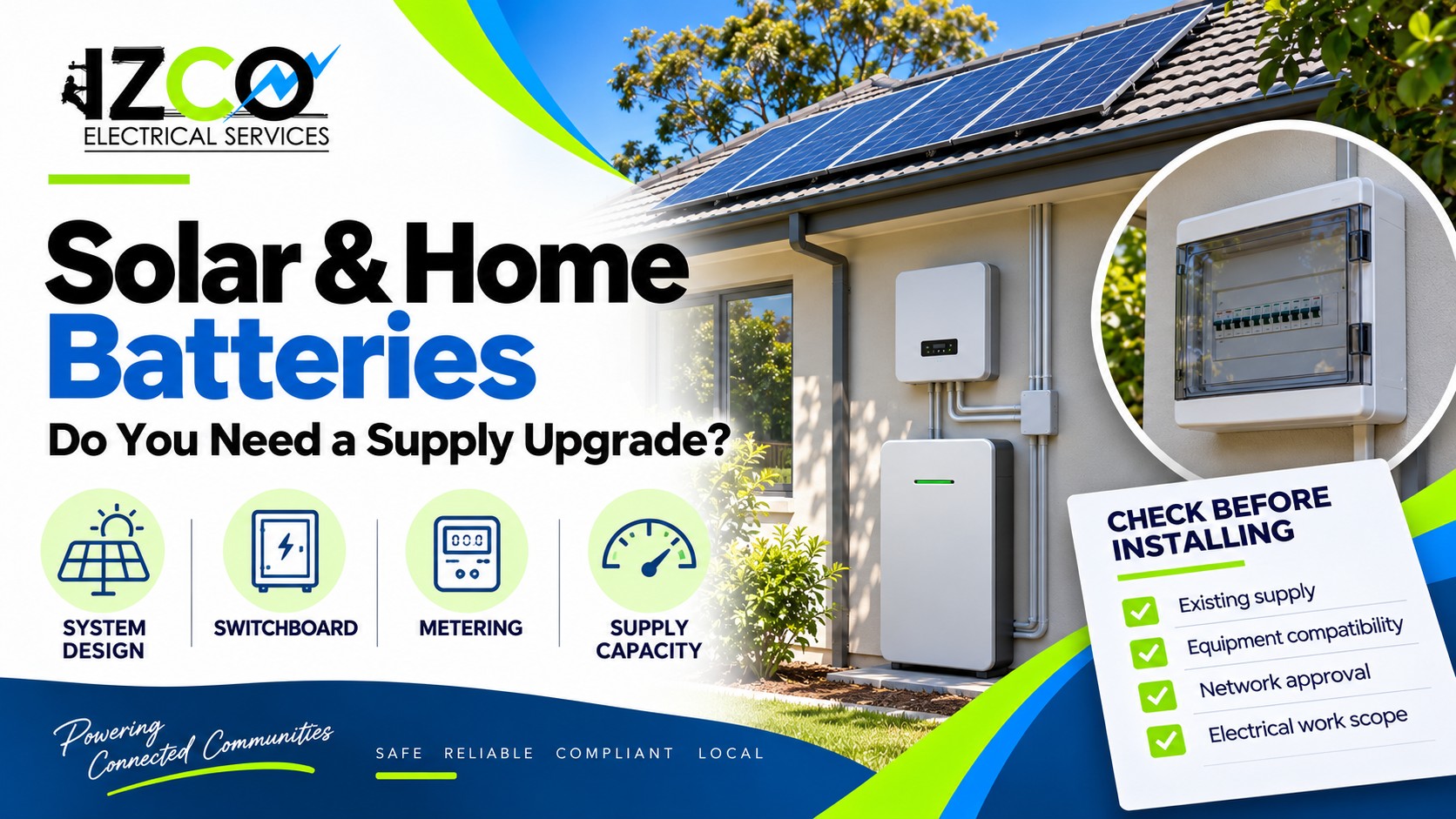
Solar panels or a home battery do not automatically mean you need a larger electricity supply. Whether an upgrade is needed depends on the proposed system, your existing installation, household demand and the network’s connection requirements. A switchboard upgrade, meter change and incoming supply upgrade are different jobs.
If changes to your service connection are required, a Level 2 electrician in Sydney can assess that part of the work alongside your solar or battery installer. Ask what needs changing and why before accepting a quote that groups everything under an electrical upgrade.
What does a solar and battery supply upgrade actually involve?
A supply upgrade changes the arrangement or capacity of the incoming electricity connection. Depending on the assessed scope, it may involve service cables, consumer mains, connection equipment or a change from single phase to three phase.
Work at the switchboard prepares or alters the equipment distributing electricity around your home. Metering work concerns how electricity flowing to and from the grid is measured. Your project may need one of these changes without needing all three.
Ask the electrician to identify the limitation being addressed. Is it the condition of the board, equipment compatibility, household demand or a requirement attached to the proposed connection?
When might the switchboard need work?
The NSW Government’s battery guide notes that an outdated switchboard may need upgrading before a solar and battery system is installed. It also recommends checking inverter and battery compatibility rather than assuming an existing solar installation is ready for storage.
Ask the installer or electrician to explain the findings from your property assessment. Request separate details for work required to accommodate the proposed system and any additional improvements you are choosing.
Replacing or extending the switchboard does not, by itself, establish that the capacity of the incoming service has increased. If the quote mentions both types of work, ask why each is needed.
Does solar or a home battery require three phase power?
There is no useful rule that every home adding solar or storage must change to three phase. Ask whether the proposed equipment and system design are suitable for the existing supply, and whether the network will approve that arrangement.
If three phase is recommended, ask what specific issue it resolves and whether a different system design is suitable. An installer should be able to distinguish a necessary change from an option intended to accommodate future plans.
Our guide to single phase and three phase power explains the connection types. Your property assessment is still needed to establish which arrangement suits the proposed work.
How do household appliances affect the assessment?
Give your electrician a picture of the whole home, not just the new solar panels or battery. Mention substantial existing loads and anything you plan to add, such as an induction cooktop, air conditioning or an EV charger.
Ask how the assessment accounts for times when solar production or battery support is unavailable or limited. Do not assume that generating electricity during the day removes the need to assess the supply for other operating conditions.
- Which major appliances may run together?
- Is any planned equipment likely to change the electrical demand?
- Does the proposed design include controls that affect how equipment operates?
- What assumptions are being used to recommend a supply change?
These are questions for a professional assessment. Do not open a switchboard, inspect service fuses or alter settings to try to establish capacity yourself.
Is network approval the same as a supply upgrade?
No. Approval concerns the conditions under which the proposed system can connect and operate. A physical supply upgrade is work on the electricity connection. One does not automatically establish the need for the other.
Ausgrid’s solar connection guidance says approval is required before solar or battery systems are turned on. The installer will usually submit the connection application and technical information. Changes to an existing system may also require updated approval.
Endeavour Energy’s solar connection process also separates the application, review, installation and metering stages. Check with your network provider, Ausgrid or Endeavour Energy where relevant to your address, for the current requirements applying to your proposal.
Ask the installer to explain any approved export conditions. Permission to export solar electricity is a separate question from how much electricity your household installation can safely draw from the network.
Will the electricity meter need changing?
Ask your installer and electricity retailer to confirm whether the existing meter suits the proposed system. Endeavour Energy explains that, where a meter is incompatible with solar, the installer contacts the retailer to arrange an upgrade or reprogramming.
Keep this item separate in the quote and programme. Confirm who is organising the metering work, whether another appointment is needed and which steps must be completed before the system can operate.
A new meter does not automatically mean the service cable or supply capacity has been upgraded.
Who handles solar installation and who handles the connection work?
Your solar or battery installer handles the system design and installation within their qualifications and scope. Confirm electrical licensing and the relevant solar or battery accreditation. The NSW battery guide recommends checking the installer’s licence and Solar Accreditation Australia accreditation.
Where specified service connection work is needed, the NSW ASP Scheme identifies the relevant Level 2 role. Individual workers also require authorisation from the applicable network. Solar or battery accreditation and ASP accreditation cover different responsibilities.
Do not assume every solar installation requires a separate Level 2 job, or that ASP accreditation alone qualifies someone to design and install the battery system. Ask who is responsible for each task. All electrical work must be performed by a licensed electrician with the required qualifications and authorisation. Never attempt it yourself.
What should you check before accepting a quote?
Request a written explanation of the assessment and the proposed work. It should make clear what is necessary for the selected system and what depends on network review or further investigation.
- The solar, inverter and battery equipment covered by the design.
- Any switchboard, metering, consumer mains or service connection work, listed separately.
- Whether a phase change is required and the reason for recommending it.
- Who will arrange network approval, metering and any power interruption.
- Testing, handover documents, exclusions and how additional work will be approved.
There is no single upgrade cost or completion period suitable for every property. Ask for an estimate based on the identified work and for any remaining dependencies to be explained.
If the assessment identifies connection work, request a quote for the required electrical supply work from IZCO Electrical. Include your proposed system details and the installer’s findings so the connection scope can be assessed.
Frequently asked questions
Can I add a battery to an existing solar system?
It depends on compatibility, the system design, the existing installation and the applicable connection requirements. Ask the installer to confirm whether your inverter is compatible and whether an updated application is needed.
Does a bigger battery automatically need a bigger electricity supply?
No automatic conclusion follows from storage capacity alone. Ask the installer and electrician to assess the proposed equipment, operating settings and whole home requirements before recommending connection work.
Should I mention a future EV charger now?
Yes. Include planned additions in the assessment so you can discuss whether preparation now is useful. That does not mean every home needs three phase or an immediate supply upgrade.
Will the battery power my whole home during an outage?
Ask the installer to specify whether the quoted design provides backup, which circuits it supports and its operating limits. Do not assume that buying a battery or upgrading the supply guarantees whole home backup.