
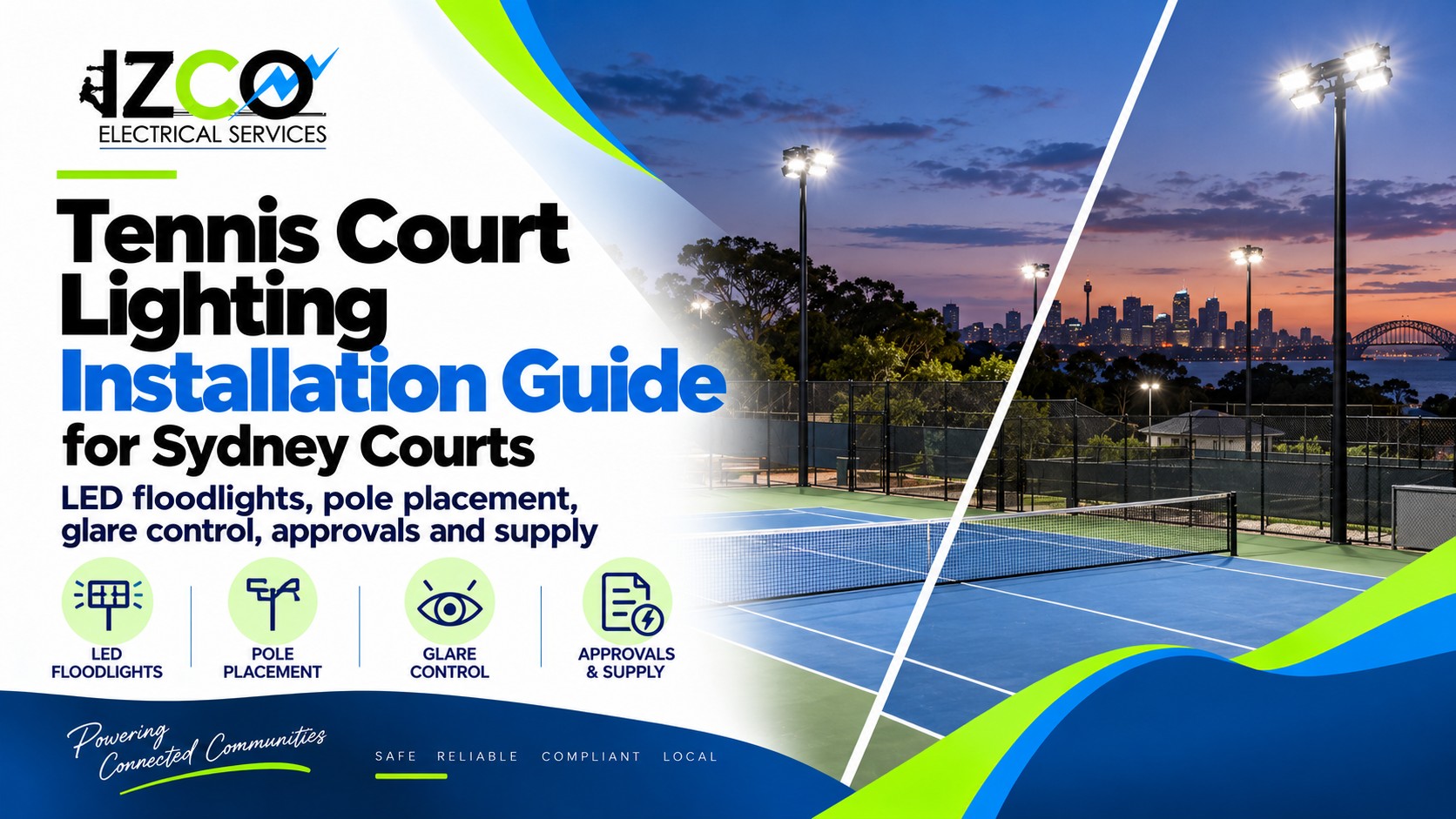
Good tennis court lighting does more than make the court bright. Players need to see the ball clearly, judge its movement and look across the net without glare. For homeowners, clubs and sports facilities, the installation also needs safe electrical equipment, a suitable supply and consideration for the neighbours.
This guide covers planning, installing and upgrading court lighting. Most of the work is ordinary licensed electrical installation; Level 2 authorisation only becomes relevant if the project involves work on the incoming network connection.
Start With How the Court Is Used
A backyard practice court and a club competition court have different needs. The design should reflect the standard of play, use after dark, nearby buildings, court surrounds and any limits from the council or facility operator. Tennis Australia’s lighting resources put ball visibility and limiting adverse effects, including spill light, at the centre of a lighting design, and they point out that many local authorities have strict spill requirements, so check planning obligations early.
Define the brief before designing: casual evening practice, coaching, club competition and video recording have different visibility expectations. Ask the designer to explain predicted illumination, uniformity and glare, not just wattage or the number of lights, so the design can be assessed before fittings are bought. Sports lighting is covered by the AS 2560 series of Australian Standards, and a lighting designer should work to the one that applies to your level of play.
What Makes Court Lighting Effective?
Uniform illumination. Large dark patches or abrupt changes in level make the ball hard to track. Assess lighting across the playing area and the run-off around it.
Glare control. Floodlights aimed into a player’s line of sight during a serve or overhead are a common problem. Aiming, shielding, mounting height and placement all affect comfort.
An appropriate lighting level. The right level depends on whether play is recreational, club or higher standard. Don’t copy a lux figure from another court.
Choosing LED Floodlights
LED fittings suit both new installations and replacements because they offer directed light and practical controls. A high wattage or lumen figure alone doesn’t show the court will be well lit. Check:
- Optics and aiming suited to tennis
- Uniformity and glare performance in the proposed layout
- Weather protection and mounting requirements
- Switching zones, timers and operating hours
- Access for cleaning, servicing and replacement
Court lighting needs its own glare and uniformity design rather than a copy of a general building retrofit. How savings are calculated for general lighting is covered in LED retrofitting for Sydney properties, and IZCO’s LED floodlight installation service covers the equipment side.
Where Should the Poles Go?
Pole number and position depend on court size, surrounding space, playing standard and design. Tennis Australia describes corner and side lighting as the two broad layouts, and neither is right for every site. Poles and luminaires shouldn’t create obstructions or glare. Foundations, nearby trees, storm exposure and maintenance access matter as much as the electrical design, and a structural specialist may need to assess the poles.
Approvals, Light Spill and Neighbours
Depending on the site, planning approval, operating-hour limits or outdoor lighting requirements may apply. Raise them before buying fittings or pouring foundations. Spill can’t always be fixed with a lower-wattage lamp: aiming, optics, shielding and the pole arrangement matter more. Identify neighbouring bedrooms, gardens and roads before settling pole positions, and for an existing court, a visit after dark shows whether the problem is glare, uneven coverage or spill, which each need a different adjustment.
Does the Electrical Supply Need Upgrading?
An existing court may have enough capacity for new lighting, while another site needs new cabling, protection or a board change. An electrical assessment should review the load, circuits, cable runs and isolation arrangements. Court lighting circuits can be installed by an appropriately licensed electrician. Only specific work on the incoming network connection needs an accredited Level 2 ASP, which could apply if the facility needs a larger supply. The background to capacity is in single-phase vs three-phase power.
Controls and Maintenance
Good controls light only the courts in use, switch off at scheduled times and avoid lights left on. They should also respect any operating-hour limits and include a clear emergency shut-off. Outdoor LED equipment still needs inspection: plan for safe access, cleaning, water ingress, fixings, cable condition and replacement parts. A design that can be maintained safely often serves better than one chosen on upfront price.
A Sensible Installation Process
- Confirm the court use, playing level and operating times.
- Arrange a lighting plan covering uniformity, glare and spill.
- Review pole positions, structural work, council requirements and access.
- Check the electrical load, cable routes and switchboard.
- Install and commission using suitably qualified trades.
- Test illumination on court and adjust aiming.
When to Replace Existing Lights
- Repeated failures, flicker or slow starting
- Patchy coverage or distracting dark spots
- Glare or spill complaints
- Deteriorating poles, fittings or cabling
- Old control gear or lamps that are hard to source
A single failed light doesn’t always justify replacing everything. Start with an assessment of the fittings, wiring, poles and actual playing needs. Re-aiming or replacing individual components can improve performance, though a poor pole layout or unsuitable infrastructure may justify a redesign.
What Affects the Cost?
Cost depends on whether it’s a simple luminaire swap or a full redesign. Poles, foundations, underground cable routes, the existing board, access machinery and commissioning all contribute. Ask for lighting design, construction, electrical work and testing to be priced separately so you can compare proposals fairly. A larger supply is a separate project with its own approvals.
Frequently Asked Questions
Do all tennis courts need the same number of poles?
No. The layout depends on court size, adjacent space, standard of play and fitting optics.
Does court lighting always need a Level 2 electrician?
No. Level 2 authorisation applies only if specified network supply or connection work is involved.
Can LED reduce maintenance?
Often, compared with older technology, but actual life depends on product quality, environment, controls and servicing.
Can I reuse the existing poles?
Possibly, if their condition, mounting positions and load capacity suit the new fittings. An upgrade doesn’t mean the poles are sound.
What causes dark patches?
Uneven spacing, unsuitable light distribution, poor aiming or failed fittings. Measurements help separate a maintenance problem from a layout problem.
Are there restrictions on when floodlights can be on?
Operating hours can be limited by approvals, local rules and neighbour considerations. Confirm them for your site and design controls to match.
Planning Court Lighting?
Whether the court is new, suffers from glare or simply needs fresh lights, IZCO Electrical can scope the installation or upgrade across Sydney. Tell us about the court through our contact page or phone 0470 123 811.