You’ll find six types of power poles in Australia, which we will briefly discuss in this blog. An accredited Level 2 electrician can only install these power poles. Level 2 electricians receive specialised training to attain the required skills, techniques and processes to work with live wires. Furthermore, Level 2 electrical contractors are licensed to work on private and public power poles and are outfitted with the latest equipment and tools to complete the job seamlessly.
Here are the six types of power poles that you’ll find in Australia:
#1. Network Power Pole
Network power poles accommodate large electrical cables adjoining your street. Typically, you’ll have a cable that runs from your property or private power pole to the network power pole in the street. These power poles also accommodate communication cables and street lighting wherever required. Network operators, such as Essential, Endeavour and Ausgrid, are liable for installing and maintaining network power poles.
#2. Lead in Power Pole
A lead-in power pole transmits the power lines across the road, not through the street, and rests across the road from a network pole. Typically, a lead-in power pole will have one connection to a network pole and several connections to houses on the roadside where the lead-in power pole has been set up. It works similarly to the dual or triple adaptor, where one supply goes in, and multiple goes out. Furthermore, lead-in power poles keep aerial cables above the road before they slide down to the attachment points on the property’s front side. Energy network operators, such as Ausgrid, Endeavour Energy and Essential, are liable for the lead in poles.
#3. Private Power Pole
A private power pole is a smaller pole installed on private property. They are required for different causes, including but not limited to safe access to the point of attachment, the transition of aerial cables and the height of aerial cables. Customers are liable for the wires running from the private power pole to the network or lead in the pole.
#4. Telecommunications Pole
Telecommunications companies set up telecommunications poles for running their network cables. Usually, they are set up where an electrical network pole doesn’t already exist to use for this specific purpose. Network operators’ sole responsibility is to install and maintain telecommunications poles.
#5. Lighting Pole
Street lighting poles are needed even in areas where the electricity network has been installed underground – for instance, and this is the case with many new developments.
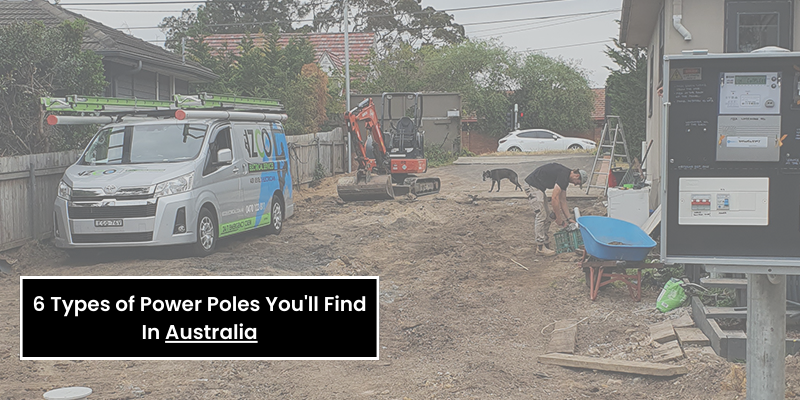
#6. Temporary Power Pole
A temporary power pole is installed inside a property to provide a connection to the network for construction purposes and is a type of private pole. A meter box is installed on the pole that serves as a power outlet and metering equipment to access electricity to construct a property or structure. Once the construction work is completed, you can dismantle a temporary power pole.
Alternatively, if installed correctly, it can be converted into a private pole to distribute power to the permanent property. These temporary power poles and the cables that pass to the network or lead in a pole are the customers’ sole responsibility.
For electrical private power pole installation or replacement, contact IZCO Electrical at 0470 123 811, and our expert team will be at your service.
Frequently Asked Questions
What types of power poles are commonly used in Australia?
Power poles can be made from materials such as timber, steel or concrete, and their design depends on whether they are part of the electricity network, a private property connection or other utility infrastructure. The suitable option for a private property should be assessed against the site and electrical connection requirements.
What type of power pole is normally used for a private property connection?
Private property poles can use different materials and configurations depending on the site, service arrangement and local requirements. Timber and galvanised steel are common options, and IZCO Electrical can recommend a suitable pole after inspecting the property.
What is the difference between a service pole and a network utility pole?
A private service pole supports the electrical connection serving an individual property, while network utility poles can carry infrastructure serving multiple customers. Ownership and repair responsibility can differ, so IZCO Electrical can inspect the arrangement and clarify whether the issue is private Level 2 work.
How do I know whether a private power pole is safe?
Leaning, rot, corrosion, cracks, impact damage, unstable foundations or problems with attached electrical equipment are reasons to arrange an inspection. IZCO Electrical can assess the pole and associated service and determine whether repair or replacement is needed.
How can I tell whether a pole is for electricity or communications?
The appearance of a pole alone may not make ownership or purpose obvious, particularly where multiple services are nearby. Do not touch or alter the equipment; IZCO Electrical can identify the electrical components within its scope and advise if another utility or provider is responsible.
Who can inspect or replace a private power pole in Sydney?
Private power pole installation and replacement commonly require Level 2 electrical authorisation because the work involves the incoming supply connection. IZCO Electrical can inspect the pole, recommend the appropriate solution and complete the authorised electrical work required for replacement.