Your electricity meter records how much power your property uses so your retailer can bill you. Meters differ in how they record that use, and the type affects which tariffs you can choose and how easily solar or a battery can be added. This guide explains the main types, how to tell which one you have, who is responsible for it and when a meter job needs an electrician. Meter installation, replacement and alteration is Level 2 work.
The Three Main Types of Electricity Meter
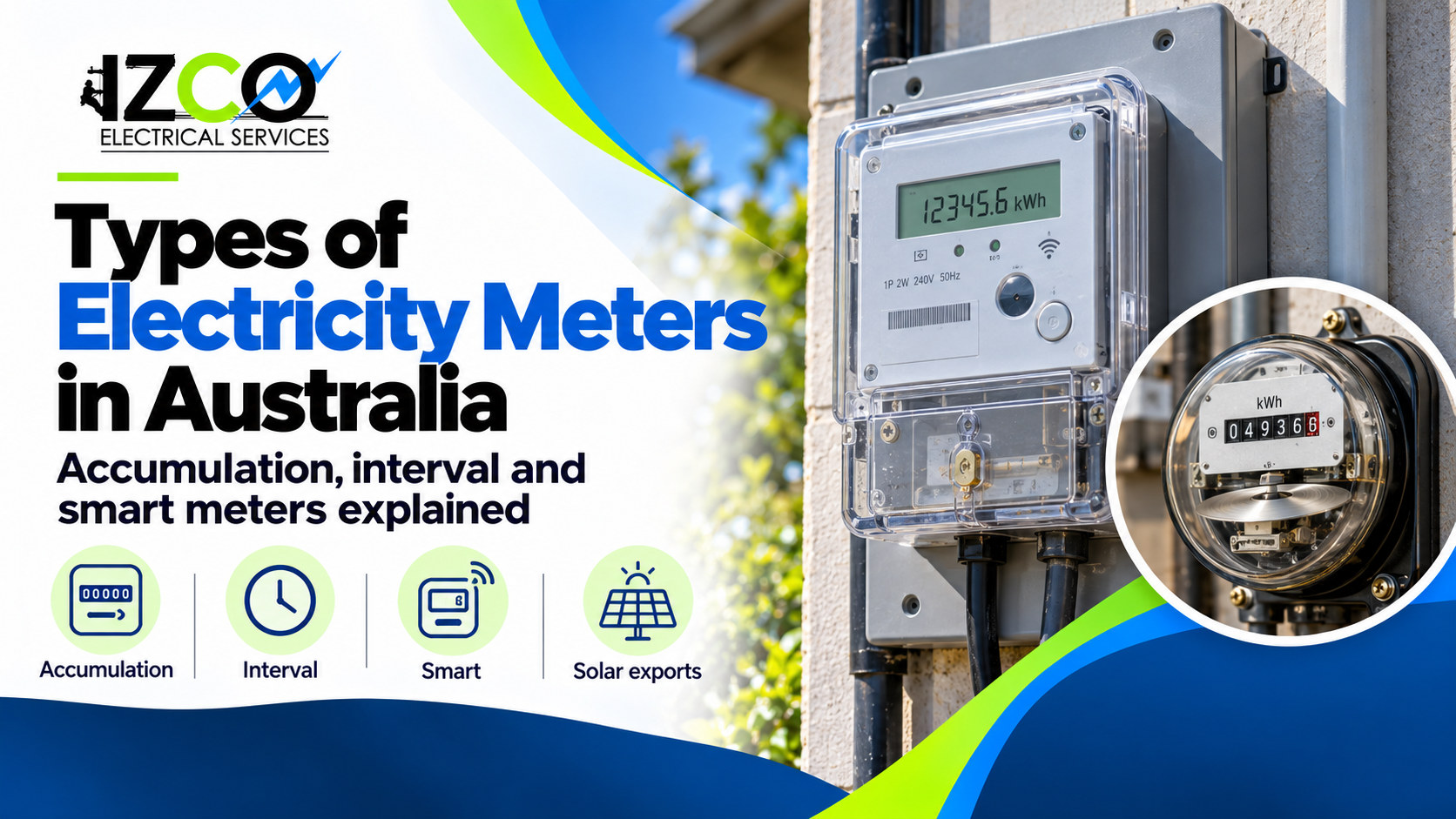
Most Australian homes and small businesses have one of three types: accumulation, interval or smart. Solar and battery systems add a fourth consideration, which is whether the meter records power going back to the grid.
Accumulation Meters
An accumulation meter records your total electricity use and nothing else. It cannot tell when you used the power, so you pay the same rate whatever the time of day. For that reason it is also called a flat rate meter.
These meters are either electronic, with a digital display, or electro-mechanical, with a dial or cyclometer display.
- Digital display: read the number shown, which is your total use so far.
- Cyclometer: read the digits left to right, like a car odometer.
- Dial: read the dials left to right. Where a pointer sits between two numbers, take the lower one.
Your bill is based on the readings your distributor or retailer collects, so check that the readings on your bill look reasonable against your own.
Interval Meters
An interval meter records your use in short blocks, commonly 30 minutes. That detail lets a retailer offer time-based tariffs, such as different rates for peak and off-peak periods, because it can see when you used the power.
Interval meters are read by the network or retailer rather than by you. Your retailer can explain which tariffs your meter supports.
Smart Meters
A smart meter is a digital meter that records your use in intervals and sends the data remotely, so nobody needs to visit to read it. Many retailers and distributors give customers access to that data through an online portal or app, which helps you see when you use the most power.
Ausgrid states that since 1 December 2017 retailers install new and replacement meters, and for residential and small business customers these are smart meters.
Meters for Solar and Batteries
If your solar system sends power back to the grid, your meter must record both what you take from the grid and what you export. A basic accumulation meter cannot do that. Ausgrid states that retailers handle meter upgrades for new solar installations, so tell your retailer when you are adding solar or a battery.
How Do You Know Which Meter You Have?
The meter face usually gives you the answer.
- Spinning disc, dials or a cyclometer: an older electro-mechanical accumulation meter.
- A digital display showing one reading: often an electronic accumulation meter.
- A digital display that cycles through several screens: often an interval or smart meter.
Your electricity bill or your retailer can confirm the type. Do not open the meter or its cover to look inside.
Who Is Responsible for Your Meter?
In Ausgrid’s network area, Ausgrid says retailers are responsible for installing new and replacement meters. Ausgrid owns most meters on its network, and it reads, tests and maintains the meters it owns. If Ausgrid finds a meter is non-compliant or damaged, it notifies your retailer, who arranges a smart meter replacement with you.
Other areas work differently in places. If you are supplied by Endeavour Energy or Essential Energy, check their websites or ask your retailer.
When Does a Meter Change Need an Electrician?
Swapping the meter itself is arranged through your retailer. An electrician comes into it when the work goes beyond the meter, for example:
- A new connection or a supply upgrade
- Relocating the meter or switchboard
- Damaged meter boxes, consumer mains or switchboard equipment
- Work at the point of supply that needs disconnection and reconnection
Some of that work needs an accredited Level 2 electrician rather than a general electrician. The guide on whether a Level 2 electrician is mandatory for meter installation explains where the line sits, and what a Level 2 ASP is covers the scheme itself.
A meter upgrade can also show that the switchboard needs work. If your board is old or crowded, read the signs you need a switchboard upgrade before booking, and see how single-phase compares with three-phase supply if you are adding large loads.
Signs a Meter or Meter Box Needs Attention
Contact your retailer or an electrician if you notice any of these:
- A cracked or damaged cover or meter box
- A blank, flickering or frozen display
- Water getting into the meter box
- A burning smell or scorch marks. Keep clear and treat it as urgent.
Do not open the meter or touch the wiring yourself.
Frequently Asked Questions
What are the main types of electricity meters used in Australia?
Accumulation (flat rate) meters, interval meters and smart meters. Solar and battery systems also need a meter that records exports.
What is the difference between an accumulation meter and a smart meter?
An accumulation meter records only your total use. A smart meter records use in intervals and sends the data remotely, so it supports time-based tariffs and avoids manual reads.
When should an old meter be replaced?
Your retailer arranges replacement when a meter is faulty, damaged or non-compliant, and when new solar is added. If you suspect a fault, tell your retailer.
Can a meter upgrade need switchboard or consumer mains work?
Yes. A meter change can show that the switchboard, meter box or consumer mains are worn or too small for the supply, and those repairs need an electrician.
Who can install or replace a meter?
In Ausgrid’s area, retailers install new and replacement meters. Electrical work around the meter, such as the switchboard, meter box, mains or point of supply, is done by licensed electricians, and some of it by an accredited Level 2 electrician.
Planning a Meter, Switchboard or Supply Change?
Tell IZCO whether you are connecting, relocating or upgrading and your suburb, and the team will explain what our meter installation service covers and what has to happen first. Request a call back or phone 0470 123 811.