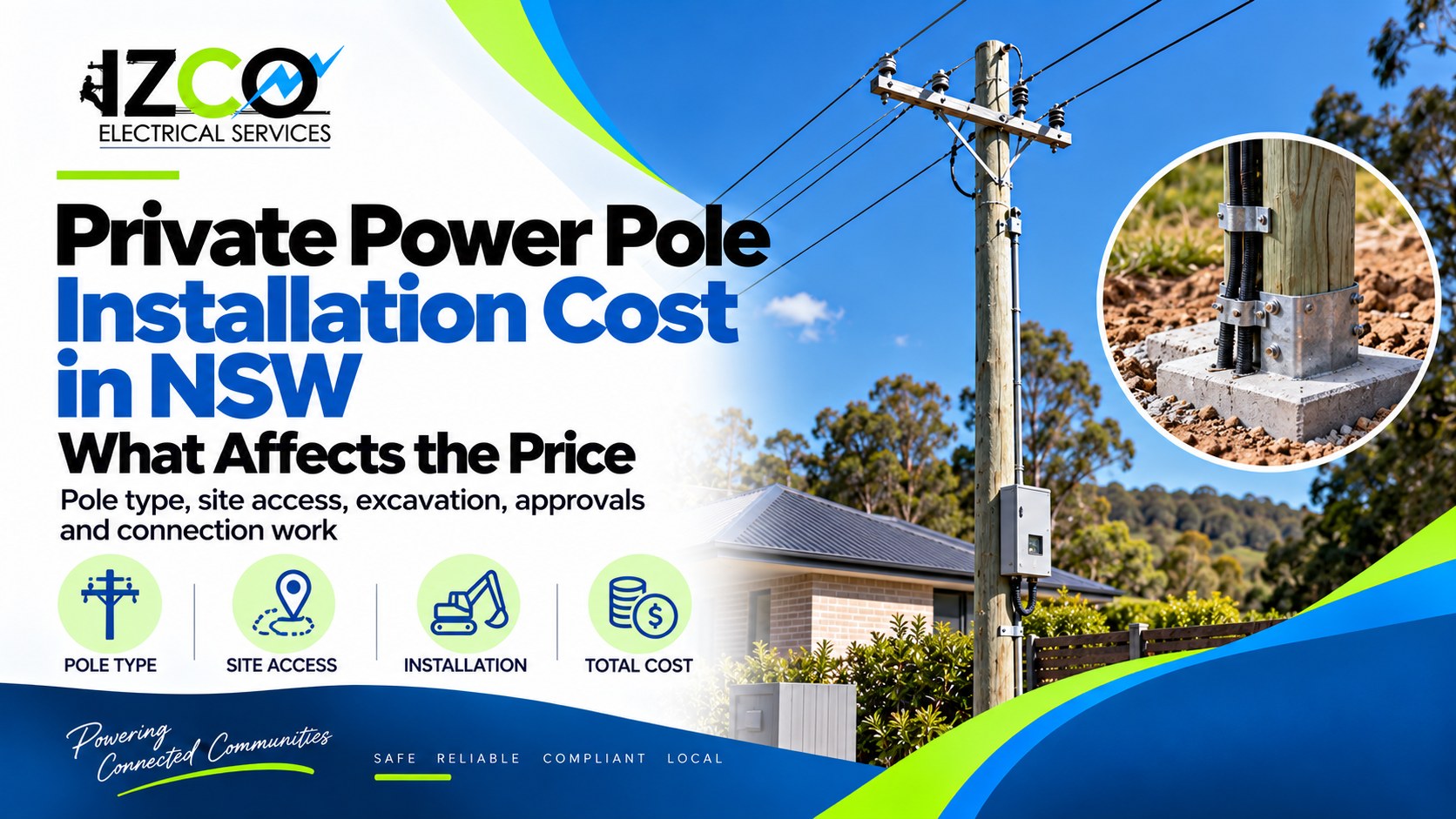
There is no single price for a private power pole, because every property is different. A short pole close to the street is a very different job from a tall pole on a long, sloping driveway with rock underneath. This guide explains what drives the cost in NSW so you can read a quote with confidence, without quoting figures that would not apply to your site.
It covers NSW and Sydney properties only. Network rules, operators and pricing differ in other states, so do not use this as a guide outside NSW. A private power pole is installed and connected by a Level 2 ASP.
What Is a Private Power Pole, and Who Is Responsible for It?
A private power pole carries the service line from the network connection to your home or business across private land. It is common on rural, acreage and larger suburban blocks, and sometimes the supply from one pole feeds more than one property.
Ausgrid says property owners are responsible for electrical assets on their property beyond its connection point. Endeavour Energy says customers must maintain privately owned assets, and in rural areas the point of supply is at the first private pole on the property. That ownership is the reason pole costs fall on the owner.
Does Your Property Need a New Private Pole?
- The distance from the network connection to the building is too long for a safe overhead span
- Trees or terrain make a direct overhead service unsafe
- An existing pole is rotten, leaning or damaged and has been flagged in a defect notice
- A new building, subdivision or secondary dwelling changes how the supply is arranged
Our guide to private power pole replacement explains how to tell whether a pole needs replacing or can be repaired.
What Affects the Cost of a Private Power Pole?
- Pole material and height. Timber and steel poles differ in cost, lifespan and maintenance. See our comparison of timber or steel power pole installation.
- Number of poles and span distance. A longer run from the connection may need more than one pole.
- Ground conditions and access. Rock, slope, tight access or tree cover increase the labour and equipment required.
- Cables and fittings. The service line, consumer mains, brackets and protective equipment all add to the scope.
- Point of attachment, meter and switchboard work. If these must change at the same time, the job grows.
- Disconnection and reconnection. Work that needs power isolated at the point of supply must be done by a Level 2 ASP and coordinated with the network.
- Removing the old pole. Taking out a damaged or redundant pole is a separate task.
- Testing and certification. Compliance testing and paperwork are part of every compliant job.
Our overview of private power pole installation and service shows how these parts fit together.
Installation, Replacement or Repair: How the Scope Changes
A repair to a bracket or a section of cable is usually the smallest job. Replacing a pole means new materials, disconnection and reconnection, and removal of the old pole. A first-time installation on a property that has never had one involves the full set of tasks, from planning the span through to testing.
Ask for the quote to say clearly which of these applies, so you can compare like with like. Our power poles service page outlines the work involved.
How to Compare Private Power Pole Quotes
Endeavour Energy recommends getting more than one quote for repairs. When you compare, check that each quote states:
- The pole material, height and number of poles
- The cable and fittings included
- Who arranges the network disconnection and reconnection
- Whether removal of the old pole is included
- Testing, the compliance certificate and site clean-up
- Anything that is excluded, such as tree trimming or carpentry
A low quote that leaves out disconnection, removal or certification can cost more once the missing items are added back.
Are There Rules You Need to Follow in NSW?
Yes. Electrical work must be done by a licensed contractor, and work that involves the network connection must be done by a Level 2 ASP. Networks inspect private poles and issue notices for poles in poor condition, so keeping yours in sound condition avoids a rushed repair later. If you are unsure who must do your job, our guide on when you need a Level 2 electrician is a useful starting point.
Frequently Asked Questions
How much does a private power pole cost in NSW?
It depends on the pole type, height, number of poles, site access, cabling and network work. The most reliable way to get a number is an itemised written quote after a site inspection.
Who pays for a private power pole?
The property owner is responsible for private electrical assets beyond the network connection point, including the pole and the lines it carries.
Do I need a Level 2 electrician to install a private pole?
Work that involves isolating or connecting to the network supply must be done by a Level 2 ASP. A site inspection will confirm what applies to your job.
How long does installation take?
That depends on access, ground conditions, weather and network coordination. A site inspection allows a realistic timeframe to be given before work starts.
Can one pole supply more than one property?
Sometimes, depending on the arrangement and network requirements. Ask for advice before assuming a shared pole is allowed.
Need an Itemised Quote for Your Pole?
Send IZCO your suburb, how far the building sits from the connection and a photo of the existing pole if there is one, and the team will arrange an inspection. Request a quote or phone 0470 123 811.