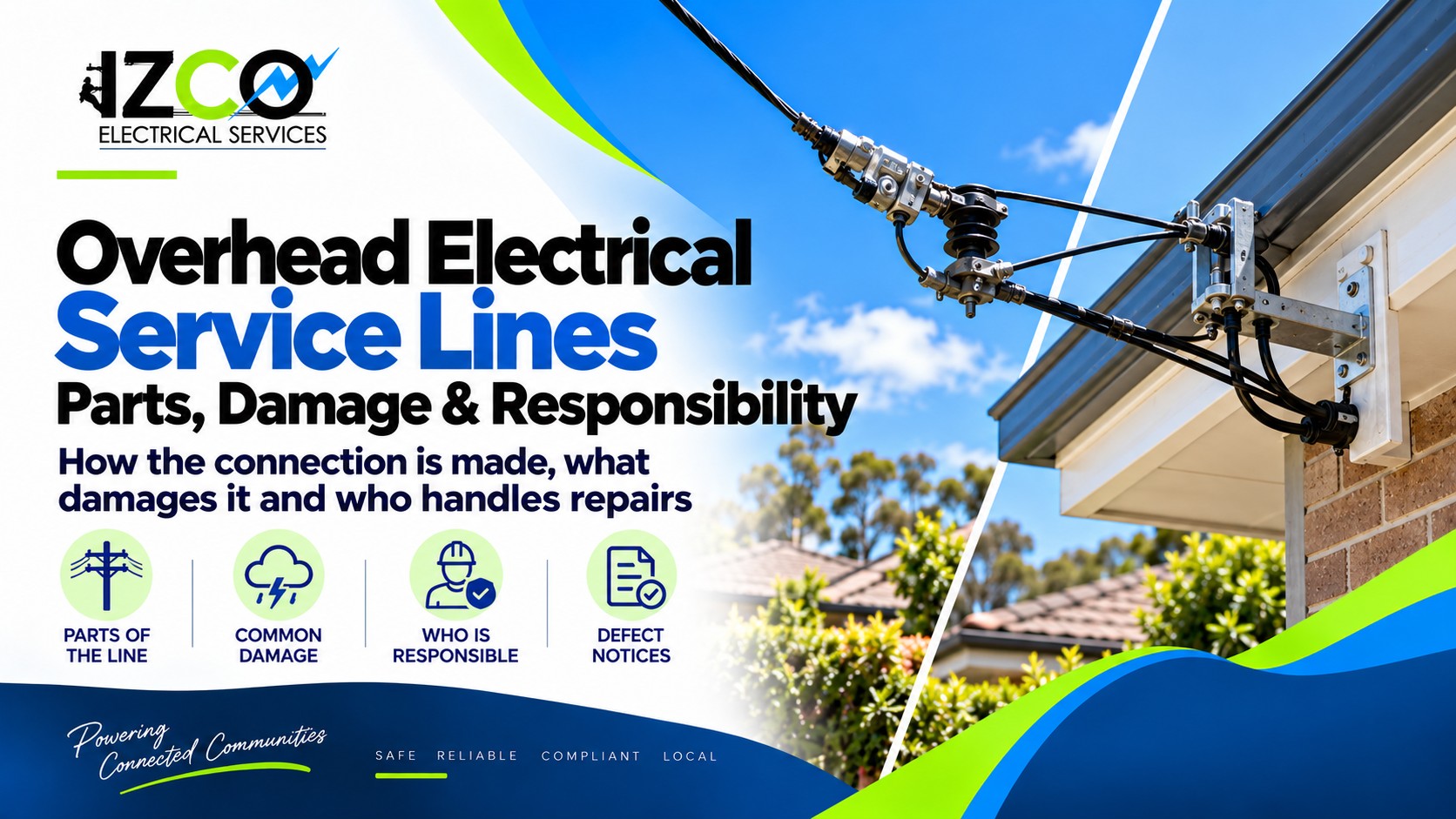
The overhead cable linking a home to the street network tends to go unnoticed until a branch brings it down, an attachment loosens or a defect notice arrives. A service connection has several components, and they don’t all have the same owner or maintenance duties. Knowing the parts makes it easier to respond safely and call the right people.
When a damaged service line crosses the boundary between private equipment and the network, an assessment by a Level 2 electrician in Sydney identifies which repair pathway applies.
What Is an Overhead Service Line?
An overhead service line runs between the distribution network and an approved connection point serving a property. It meets either a secure attachment on the building or a private pole, and customer wiring then carries electricity to the switchboard. The street conductors and your service arrangement are not necessarily maintained by the same organisation, so check the distributor’s documents and the specific asset’s ownership before assuming who is responsible.
The Parts of an Overhead Connection
Network pole and street conductors. The distributor manages these. Network faults are reported to its fault line.
Service cable and point of attachment. The cable connects to an approved structure at the point of attachment. The bracket, the roof or wall structure and the clearances must all be suitable, and a loose or damaged attachment can compromise the whole connection.
Private power pole. Larger or awkwardly shaped properties may use a private pole. Its foundation, structure and fittings need attention when they deteriorate, and the process is covered in private power pole replacement.
What Damages Overhead Service Lines?
- Falling branches and vegetation touching the cable
- Storms, strong wind and airborne debris
- Vehicles or construction equipment hitting low cables
- Corroded brackets, worn fittings and damaged insulation
- Extensions or roof changes that reduce the required clearances
Flickering lights or interruptions can point to other electrical problems and aren’t proof the service cable is faulty. A qualified assessment is needed to find the cause.
What to Do About a Fallen or Sagging Cable
Treat every fallen or sagging line as live. Ausgrid advises staying at least 8 metres, or about two car lengths, away from fallen wires and anything touching them, and keeping people and pets back. Call 000 if anyone is in danger, then report the hazard to your network: Ausgrid on 13 13 88, Endeavour Energy on 131 003 or Essential Energy on 13 20 80. Don’t cut branches off the line, lift it or inspect an attachment from a ladder, because power can return without warning. More emergency steps are in what to do during an electrical emergency.
Who Pays for Repairs?
Responsibility depends on the connection boundary, asset ownership and network rules. The distributor generally looks after network poles and conductors, while the owner may need to maintain private poles, structural attachments and other customer-owned assets. The cable’s physical position doesn’t settle liability, particularly when it crosses another property or shared access. Ask the distributor or an authorised contractor to name the defective part and the party responsible before arranging work.
What a Defect Notice Means
A distributor can issue a defect notice for unsafe or non-compliant equipment, with a required response. The fix might be a bracket, a service cable, a private pole or another component. A notice doesn’t automatically mean converting to underground supply, which is weighed up in overhead vs underground power lines. Follow the deadline on the notice, keep a copy and arrange an assessment. Defect notice repairs shows how that work is carried out.
How an Overhead Service Repair Is Planned
- Identify the damaged or non-compliant asset and who is responsible for it.
- Confirm the provider’s Level 2 accreditation and distributor authorisation.
- Assess clearances, access and the attachment structure.
- Arrange approved isolation, outage or disconnection.
- Repair or replace equipment, test the connection and arrange compliant reconnection.
Some repairs mean replacing old or incompatible equipment rather than patching a cable. A quote should separate service cable work from building repairs, pole replacement and other electrical work, and say who coordinates with the network and whether you’ll lose supply. Photos taken safely from the ground, the defect notice and the address are the most useful things to provide.
Is the Problem on Your Side or the Network’s?
If several neighbours lose power at once, a wider network issue is likely. If only your property is affected, the cause could be the service connection or an internal fault, but neither observation replaces testing. Check whether the network has announced an outage, then describe the symptoms to the right provider. Don’t open the switchboard or test the incoming cable yourself.
Moving an Overhead Line for a Renovation
A new storey, balcony, driveway or roof extension can change the safe clearance around a service cable. The line may need to be moved or the attachment redesigned before building work blocks access, and an unqualified worker must never tie a cable back. Planning for this is covered in renovation electrical work and supply changes.
Reducing Future Problems
- Check for obvious damage from a safe distance after severe weather.
- Use suitably qualified contractors for tree work near power lines.
- Allow for cable clearances when designing an extension or driveway.
- Keep defect notices and past work records.
- Arrange an inspection if a pole moves or an attachment loosens.
There is no single replacement interval for service lines. Insulation, fixings, supports, exposure and current distributor rules matter more than age, and an inspection after a severe storm or major building change is sensible.
Frequently Asked Questions
Can I repair my overhead cable myself?
No. Don’t approach or work on the service cable. Connection tasks need suitably licensed and authorised people.
Is a damaged private pole always the network’s responsibility?
No. Private pole responsibilities can rest with the owner, so check the specific asset and connection documents.
What if an overhead cable touches a tree branch?
Keep away from both. Don’t prune or pull it. Report it to the network operator or a qualified contractor so work can be planned around electrical safety rules.
Does flickering lighting prove the service line is faulty?
No. Loose connections, supply issues and faults inside the installation can all cause it. A licensed electrician can find the cause, and suspected network faults should also be reported to the distributor.
Can an attachment bracket be repaired while the power is on?
Don’t assume so. The safe method depends on the equipment and authorisations, and the contractor must decide on isolation and network coordination.
Overhead Line Damage or a Defect Notice?
IZCO Electrical installs and repairs overhead powerlines as a Grade A Accredited Service Provider. For storm damage, relocation or a notice from your network, read about our overhead powerline service or phone 0470 123 811.