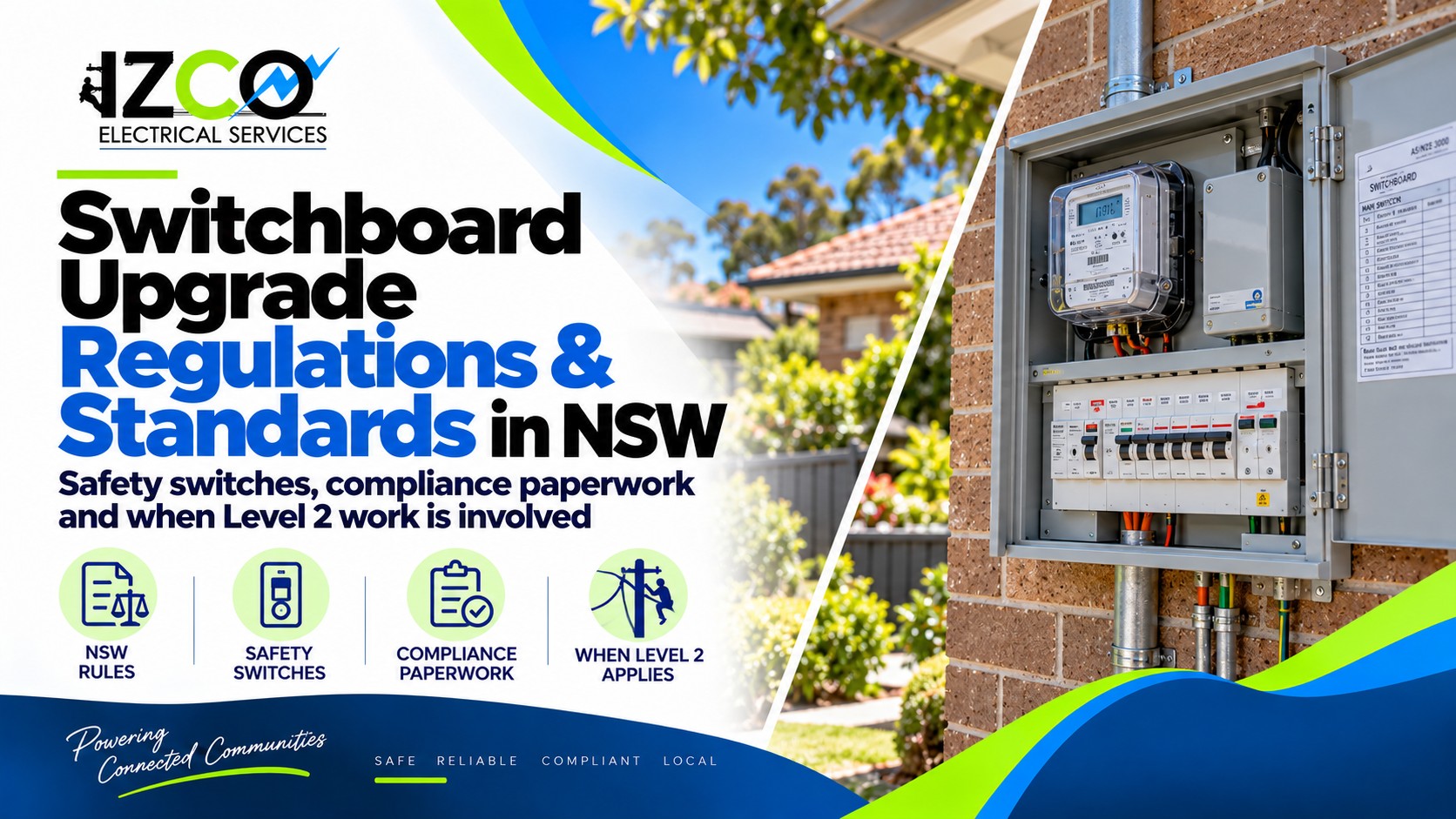
A switchboard controls and protects the circuits in a property. An older fuse box may still work, but a renovation, new circuits or a safety defect can show that its equipment no longer suits the installation. The decision to upgrade should rest on a professional assessment and the requirements that apply to the work, not on a blanket claim that every older board must go.
This article covers the rules, standards and paperwork. If you are trying to decide whether yours needs attention, start with the warning signs of a failing switchboard. If the upgrade also involves the meter or incoming supply, a Level 2 electrician in Sydney does that part.
Which Rules Apply to Switchboard Work in NSW?
Electrical wiring work in NSW is subject to electrical safety legislation and standards. AS/NZS 3000, the Wiring Rules, is central to installation work, alongside the NSW Service and Installation Rules and, where the service connection is affected, the local distributor’s requirements. The contractor should confirm which editions and amendments apply to your project.
Newer standards don’t automatically mean every existing switchboard must be replaced immediately. Requirements depend on the board’s condition, the work being done and the applicable law.
Mandatory, Triggered or Optional?
An electrician should be able to tell you which category each recommendation falls into:
- Mandatory rectification, such as damaged, overheated or unsafe equipment.
- An upgrade triggered by alterations, such as adding circuits that need current protection arrangements.
- An optional improvement, such as spare capacity or tidier layout.
This matters most when an older board is still working but a renovation is planned, because it shows what you must do versus what you may choose to do.
Safety Switches and Circuit Protection
A modern board typically uses circuit breakers and residual current devices (RCDs). Their jobs differ: overcurrent protection handles overloads and short circuits, while an RCD responds to certain leakage-current conditions. Neither makes an installation risk-free. When adding or altering a circuit, ask the electrician what RCD protection it needs and whether other changes are mandatory.
When Is an Upgrade Required?
An upgrade may be needed because the board is unsafe, its layout can’t take compliant new work, or a defect must be corrected. The scope ranges from replacing protective devices to broader enclosure, wiring and consumer mains work.
- Damaged, overheated or deteriorating parts
- Old fuse arrangements or insufficient suitable protection
- Renovations or extra circuits
- New loads that need a capacity assessment
- A defect notice or inspection finding
Some problems can be fixed without replacing the board. Others need a substantial upgrade, and only an inspection shows which.
The Certificate of Compliance for Electrical Work (CCEW)
A CCEW is the record that electrical wiring work has been tested and meets the requirements. In NSW all certificates must now be submitted through the Building Commission NSW eCert portal, which has been mandatory since 1 July 2026, and no later than seven days after the electrical test, as set out in the NSW Government’s electrical compliance requirements.
A CCEW is not the same as a distributor’s approval for a new supply. The certificate covers electrical compliance, while the distributor’s connection approval covers a different part of the process, and a project may need both. Keep the invoice, approved variations, test results and certificate together, since they help when a defect is investigated or another contractor later changes the installation.
Does a Switchboard Upgrade Need a Level 2 Provider?
No. A licensed electrician can do many internal switchboard upgrades. An accredited Level 2 provider becomes involved when the project includes work on the incoming supply connection, certain network service protection devices, or disconnection and reconnection. Metering may involve extra parties, and meter installation separates those roles. The contractor should say which part of the job needs which authorisation.
What Happens During an Upgrade
- The electrician inspects the board, connected circuits and load.
- A scope is prepared, including protective devices and any supply work.
- Outages, access and distributor requirements are arranged.
- Licensed personnel alter or replace the board and wiring.
- The work is tested, labelled and documented.
How New Loads Affect Board Design
An EV charger, large air conditioner or electric cooking can affect circuit capacity, protective devices and the available supply. The electrician has to consider how the loads run together rather than assessing each appliance alone. A load assessment may support keeping the existing supply, adding load management, adding circuits or pursuing a supply upgrade, so claims that every EV charger needs three-phase or a new board are unreliable. The supply side is covered in single-phase vs three-phase power.
Apartments, Strata and Commercial Sites
Units may be affected by common-property boards, shared supply equipment and building access limits. Commercial boards can serve very different loads from a home, with business-critical equipment, controlled shutdowns and multiple contractors. Confirm which board is being changed, whether it affects your lot, common property or both, and who arranges access and notice to residents. None of this makes the job Level 2 work by itself; that depends on whether the network connection is affected.
Before You Approve an Upgrade
- Ask which faults or compliance problems have been found.
- Confirm whether the recommendation is full replacement or a limited alteration.
- Request the protection arrangements and testing scope.
- Ask whether the distributor or a metering provider must attend.
- Clarify outage length, documents and making good.
Frequently Asked Questions
Does an old fuse box automatically breach the law?
Age alone doesn’t decide it. Condition, configuration, proposed work and the applicable rules determine whether an upgrade is required.
Is a safety switch the same as a circuit breaker?
No. They protect against different faults, and an electrician can explain which devices your installation needs.
Will the power go off during an upgrade?
Almost always. Replacing or significantly altering a board needs planned isolation, with any network coordination arranged beforehand.
Does adding a circuit trigger modern safety-switch requirements?
It can. The requirements depend on the work and standards, so ask the electrician what RCD protection the new circuit needs.
Do landlords have different obligations?
Rental properties carry electrical safety responsibilities in NSW, but the details depend on the tenancy and property. Check current requirements rather than assuming an old board is acceptable.
Can a new board go in without replacing the consumer mains?
Sometimes. The incoming cables need to be assessed for condition, capacity and compatibility, and unsuitable or damaged cables can become part of the scope.
Book a Switchboard Inspection
A clear scope and written options make a switchboard upgrade easier to approve. IZCO Electrical upgrades and installs switchboards across Sydney, with Level 2 connection work available under its Grade A ASP accreditation. Request a call back or phone 0470 123 811.