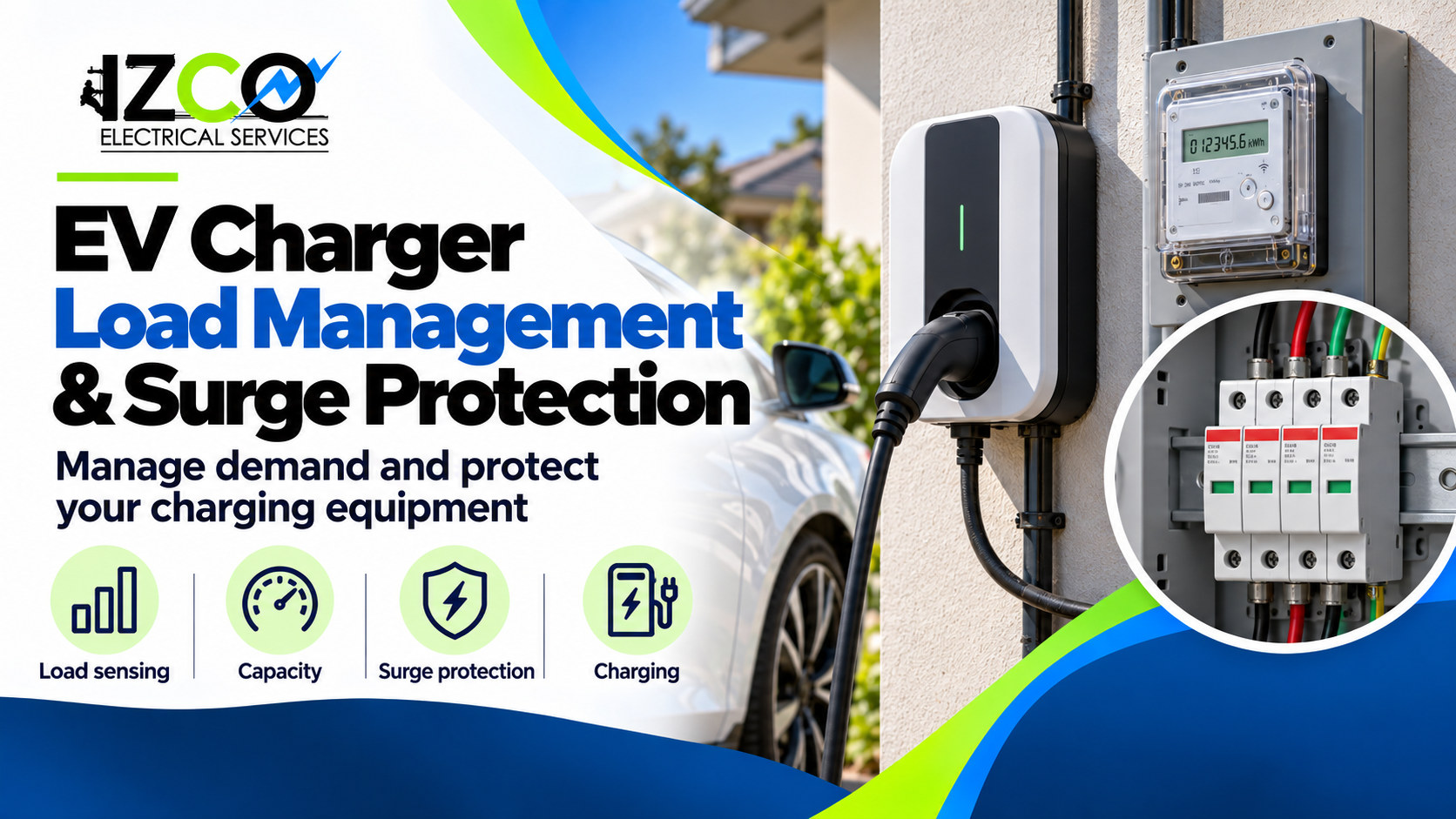
An EV charger is one of the largest loads in a home, and it runs for hours. Two features help manage the risks that come with it: dynamic load management, which controls how much power the charger draws, and surge protection, which guards against voltage spikes. This guide explains what each does, whether you need them and what to ask your installer.
What Is Dynamic Load Management?
Dynamic load management (DLM) is a system that adjusts the charger’s output so the property’s total demand stays within safe limits. A sensor measures the property’s use, a communication link tells the charger what is happening and a control unit lowers or raises the charging power accordingly.
As an illustration, if the property’s supply can carry 63 amps and the rest of the house is using 55 amps, the charger is limited to what remains. When the oven or air conditioner turns off, the charger speeds up again.
Why Load Management Matters
- It helps avoid overloading the switchboard, supply or main switch when the charger and other appliances run together.
- It can reduce nuisance tripping.
- It can help a property with limited capacity run a charger without an immediate supply upgrade, where the network and the installer agree it is suitable.
- It works well where more than one charger shares a supply, such as in a car park.
Load management does not make your supply bigger. It shares the capacity you already have.
What Is Surge Protection?
Surge protection limits the effect of short voltage spikes on your equipment. Spikes can come from lightning, network faults, supply switching and large appliances turning on or off. An EV charger contains electronics that these spikes can damage.
- Switchboard protection: a surge protection device at the switchboard helps protect the whole installation.
- Protection near the charger: a second device close to the charger can protect against surges that reach it.
Surge protection reduces the risk of damage. It cannot guarantee a charger will survive a direct lightning strike.
Do You Need Both?
They solve different problems. Load management controls the amount of current the charger draws. Surge protection guards against sudden voltage spikes. A charger on a switchboard with plenty of spare capacity might not need load management, but surge protection is worth discussing for any installation. Ask your installer which of the two suits your property and why.
How Load Management Can Make Charging Faster and More Convenient
Without it, a cautious installer might limit the charger to a low fixed power so the rest of the house can never overload the supply. With it, the charger can use more power when the house is quiet, such as overnight, and step down when demand rises.
Planning It Properly
- Have your electrician assess the switchboard, supply and expected loads first. See the signs you need a switchboard upgrade.
- Choose a charger that supports load management if your capacity is limited.
- Ask whether your network needs notification or approval for the installation.
- Follow the wiring rules and the manufacturer’s instructions. A licensed electrician must do the work.
The full process is in the EV charger installation guide, and the basics of home charging are in can you charge an electric car at home.
Frequently Asked Questions
What does dynamic load management do?
It reduces the charger’s output when the rest of the property is using a lot of power and increases it again when demand falls.
Does load management mean I do not need a supply upgrade?
Not always. It can help where capacity is limited, but whether it is enough depends on the supply, the loads and the network’s requirements.
Will load management slow down my charging?
Only when the rest of the property is using a lot of power. At quiet times the charger can run at higher output.
Does a surge protector protect my charger from lightning?
It reduces the risk from surges but cannot guarantee protection against a direct strike.
Do I need a switchboard assessment first?
Yes. It tells you what capacity you have and what the installation needs.
Adding a Charger to a Busy Switchboard?
Tell IZCO your suburb and how many chargers you plan to add, and the team will check your supply and recommend load management or surge protection where it makes sense as part of our EV car charger installation service. Request a call back or phone 0470 123 811.